

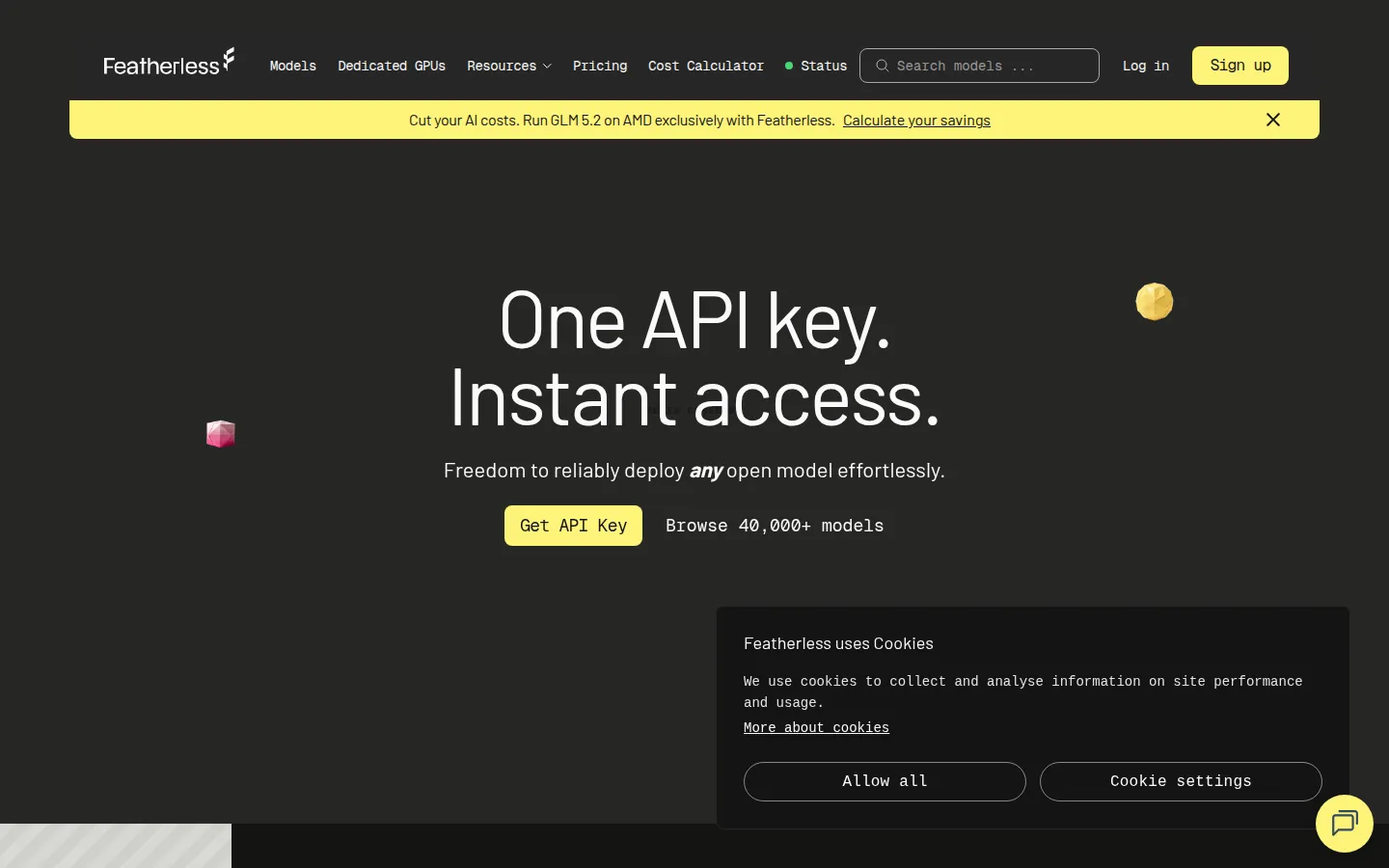
Large open-weight catalog
Featherless maps compatible public repositories from Hugging Face into a serverless catalog. Its model endpoint reports identifiers, context limits, deployment state and other metadata. Availability through the API does not transfer authorship or validate a model card's claims; the source repository still governs license, intended use and lineage.
Roleplay-client integration
The API follows OpenAI-compatible request shapes, so a client can usually connect by changing its base URL and key. Character frontends can select individual roleplay or creative-writing fine-tunes without running local hardware. Prompt construction, character memory and card storage remain the client's job; Featherless supplies model inference rather than a complete companion interface.
Access model and cold starts
Subscriptions allocate access by model size and concurrent units, with a large shared catalog rather than one fixed model. Serverless availability can involve hot and cold deployment states, so first-token latency may differ by model. The service documents broad architecture compatibility, but an arbitrary LoRA or GGUF file cannot simply be uploaded as though every format were supported.
Privacy and adult-content limits
The official FAQ says prompts and completions sent to the API are not logged. This is a hosted-service statement, not local execution, and account or operational metadata can still exist under the current privacy policy. Roleplay tags do not guarantee an uncensored response; model fine-tuning, system behavior and service rules all remain relevant, and sensitive chats should avoid unnecessary identifying information.
Technical context
Featherless serves compatible open-weight LLMs through an API; model cards still define architecture while the service supplies inference.