

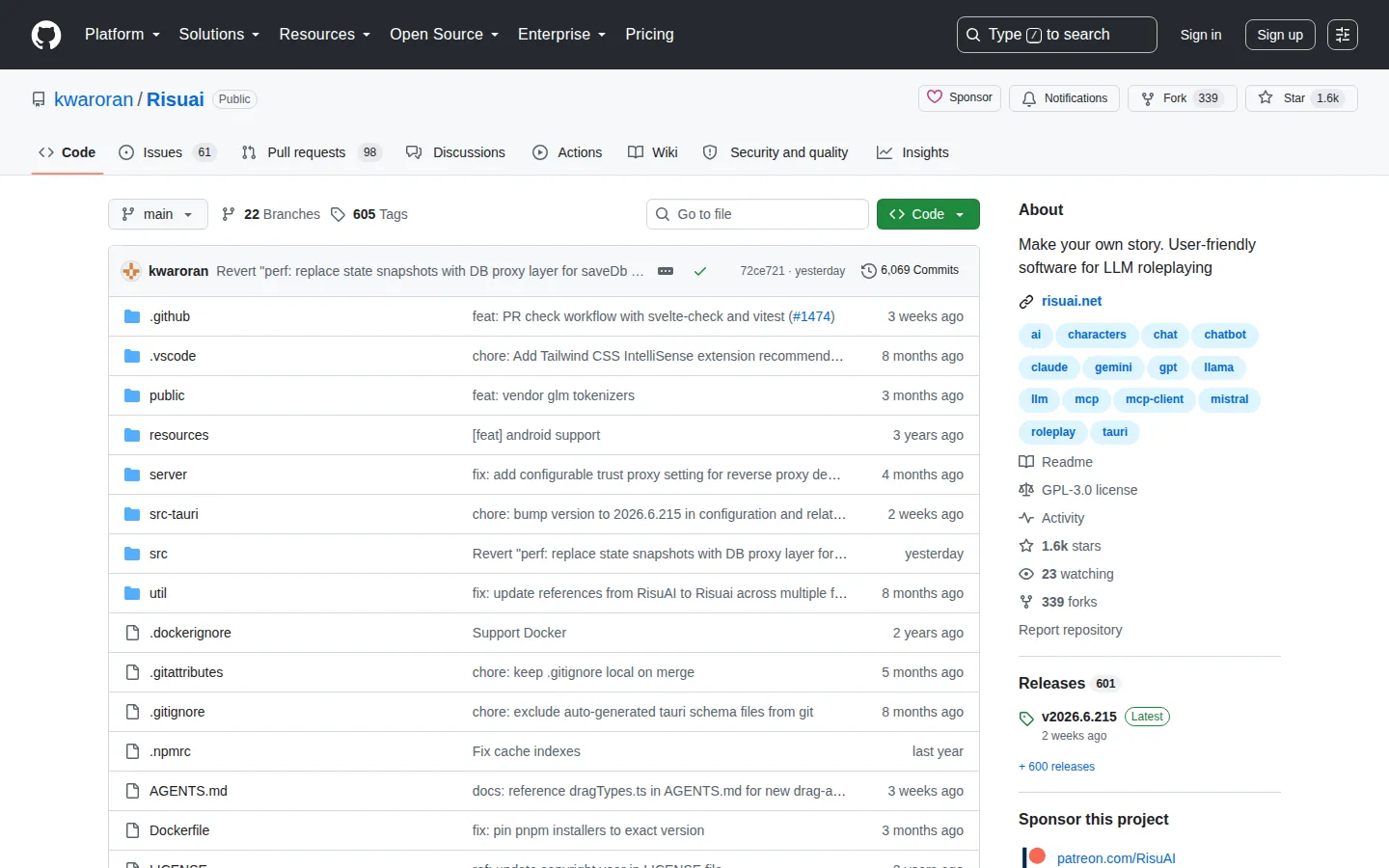
Frontend, not model
RisuAI assembles a roleplay prompt and presents model output, but it does not define one fixed LLM. Its provider list includes commercial APIs, routed services such as OpenRouter, and local endpoints. This separation is important for adult use: a character can remain the same while moderation, context size, cost and data handling change with the selected provider.
Characters and context systems
Characters can include expression images and other assets, while group chat supports multiple characters in one conversation. Lorebooks inject setting facts when relevant, and the documented HypaMemory and SupaMemory systems compress or retrieve longer-running context. These mechanisms can extend continuity but cannot guarantee perfect long-term memory; summaries and retrieval can omit or distort details.
Plugins, scripts, and portability
RisuAI supports plugins, prompt-order controls, variables, regex transformations, translation and TTS. The plugin API uses explicit permissions for sensitive capabilities and provides storage scoped to a save. That flexibility also creates a trust boundary: users should inspect third-party plugin code and permissions before giving it access to chat data or network requests.
Deployment and privacy
The project can run in a browser, packaged client, or self-hosted environment. Self-hosting the frontend does not by itself make a conversation local; prompts still leave the device when the configured model endpoint is remote. A genuinely local path requires a local inference server such as llama.cpp or KoboldCpp and settings that point RisuAI to it.
Technical context
RisuAI is a frontend over local or hosted inference; this dossier maps its characters and memory controls to the model stack below.