

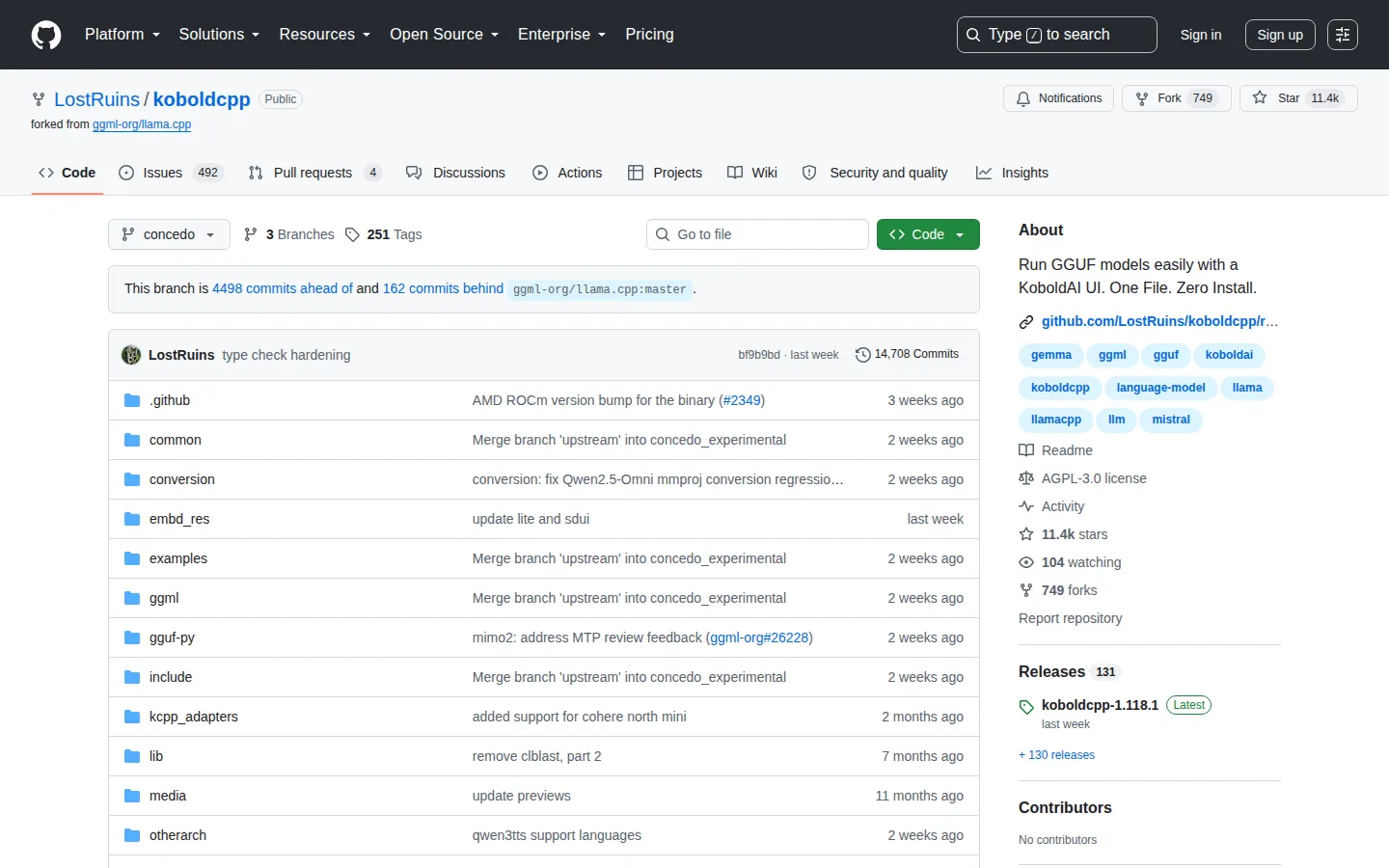
Overview
KoboldCpp is a local inference engine for running large language models on your own hardware, built on top of the widely used llama.cpp project. Its defining feature is distribution as a single executable file: there's no installer, package manager, or set of dependencies to configure separately, which has made it a common entry point for running local LLMs without a Python environment. It is maintained by the developer known as LostRuins/Concedo.
Installation and access
KoboldCpp ships as precompiled binaries for Windows, macOS, and Linux. Running it is typically a matter of downloading the executable, pointing it at a downloaded GGUF model file, and launching. The built-in launcher UI exposes options like context size and GPU layer count without requiring command-line use, though all settings are also available as flags for scripted or headless deployment.
Model and format compatibility
KoboldCpp runs GGUF-format models (and retains backwards compatibility with the older GGML format), inheriting broad model support from its llama.cpp foundation. It supports quantization levels ranging from more aggressive compression (Q2_K, Q3_K variants) up through higher-fidelity options (Q5, Q6_K, Q8_0) and full-precision F16, letting users trade output quality against VRAM and disk footprint. Context size is configurable via the --contextsize flag, with RoPE scaling techniques available to extend a model's effective context beyond its original training length.
Interface and workflow
KoboldCpp itself includes a minimal built-in web UI (Kobold Lite) for direct chat and story-writing use, but in practice it's frequently run purely as a backend, with a separate frontend such as SillyTavern connected over its KoboldAI-compatible or OpenAI-compatible API for the actual chat interface, character cards, and formatting.
Hardware requirements and performance characteristics
KoboldCpp runs on CPU alone, but GPU inference substantially improves speed and is supported through CUDA on NVIDIA cards, Vulkan (which works across GPU vendors), and HIP/ROCm on AMD cards. The --gpulayers flag controls how many of a model's layers use GPU offloading, letting users tune performance against available VRAM; an --autofit option can determine a reasonable layer split automatically. As a concrete reference point, the project's own documentation notes that a 6GB NVIDIA RTX 2060 can comfortably offload around 32 layers of a 7B model at Q4_0 quantization with a 2048-token context.
Community and ecosystem
KoboldCpp is widely used as the local backend of choice for SillyTavern-based roleplay setups because of its single-file simplicity and broad GGUF compatibility, and models used with it typically come from community sources such as Hugging Face.
Content moderation posture
KoboldCpp is commonly used for uncensored, NSFW-oriented local roleplay, but this reflects the models users choose to load rather than anything the software does itself. KoboldCpp ships with no content filter and applies no moderation of its own; the same executable will run a heavily safety-tuned model exactly as faithfully as it runs an explicitly uncensored one: the resulting behavior is entirely a property of the loaded GGUF file.
Important distinctions from adjacent tools
KoboldCpp is an inference engine, not a chat interface: it's typically paired with SillyTavern for character-card roleplay in the same way LM Studio pairs a GUI model manager with its own chat window. Compared to LM Studio, KoboldCpp trades a polished model-browsing GUI for a lighter-weight, single-file executable and finer-grained manual control over context size and GPU offloading.
Technical context
KoboldCpp sits between GGUF weights, CPU/GPU execution, an API, templates and character front ends.