

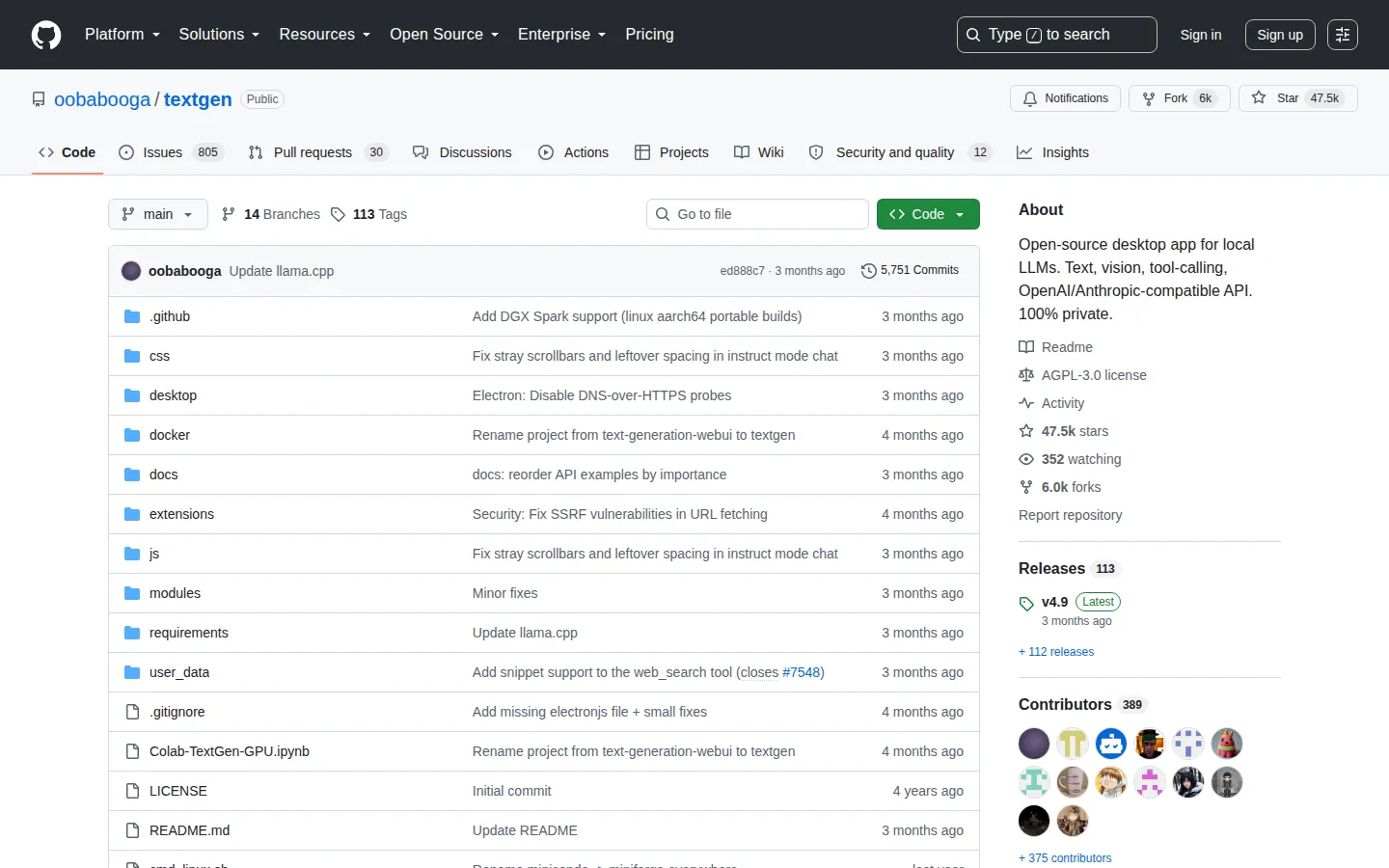
Local LLM workbench
text-generation-webui combines model loading, sampler controls, prompt formatting and conversation in one local interface. Character chat modes apply a persona and template before the recent conversation. Because a mismatched chat template can damage instruction-following or character voice, changing model families often requires more than selecting a new file.
Backends, formats, and memory
The project supports backends including llama.cpp, Transformers and ExLlama variants. Portable builds focus on GGUF, while full installs support additional model layouts. Quantization can make larger models fit less memory, with a possible quality or speed tradeoff. Conversation length remains bounded by the loaded model's context and the space consumed by character instructions.
API and client integration
OpenAI- and Anthropic-compatible endpoints let another frontend, automation or roleplay client use the loaded model without sharing it with an outside provider. This makes text-generation-webui a backend for tools such as SillyTavern. API binding and authentication require care: exposing a local generation server beyond a trusted device or network can reveal prompts and consume hardware resources.
Training, privacy, and limits
The interface documents LoRA fine-tuning on chat or text datasets and can resume interrupted runs. Training has materially higher hardware and data-preparation demands than inference. The project states that it can operate fully offline with no telemetry, but installing third-party extensions or enabling remote tools changes that boundary. A locally run uncensored model removes a service filter; it does not remove consent, safety, or legal responsibilities.
Technical context
The WebUI combines multiple local inference backends with templates and LoRA training; these dossiers separate execution from adaptation.