
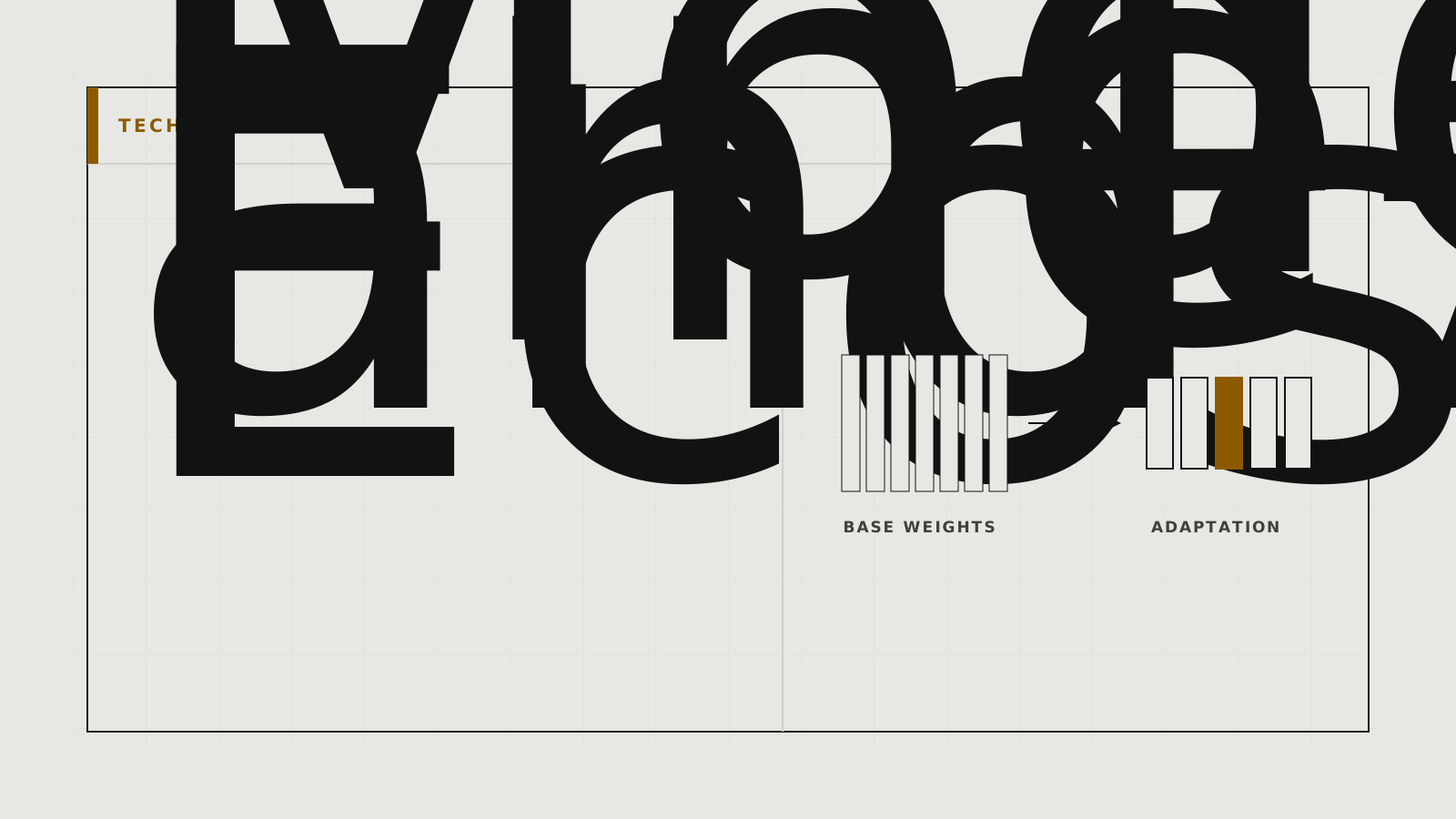
An ecosystem, not one training command
Adaptation begins before optimization: choose a documented base model, curate permitted data, caption it consistently, select target modules, record hyperparameters, validate checkpoints, package weights and metadata, then distribute them with a model card. Weakness at any stage can create an adapter that loads successfully but memorizes, drifts, or misrepresents its provenance.
Full fine-tuning updates many or all weights. DreamBooth personalizes a model using a small subject set plus preservation strategies. Textual inversion learns token embeddings. LoRA freezes the base and learns low-rank updates to selected layers. These artifacts are not interchangeable.
LoRA and base compatibility
LoRA represents weight changes with smaller low-rank matrices. Rank, target modules, scaling, optimizer, captions, and data determine what it learns. At inference the adapter’s update is combined with the base weights, optionally at a user-controlled strength.
An adapter is defined relative to a base architecture and often a specific checkpoint distribution. SD 1.5, SDXL, Pony, Illustrious, NoobAI, FLUX, and SD3 adapters should not be mixed merely because interfaces use the word “LoRA.” Metadata and model cards should identify the base and intended loader.
Dataset and validation practice
Character adaptation needs varied, authorized training data that separates identity from pose, clothing, setting, and camera. Repetition or narrow framing encourages overfitting. Captions decide which features become explicit concepts and which remain entangled. Validation should test held-out prompts, seeds, poses, lighting, and adapter strengths rather than selecting only attractive training-like samples.
Loss curves do not establish likeness quality, consent, or generalization. Preserve dataset provenance, license, hashes, configuration, and representative failures. Avoid training sexualized likeness adapters from images of a real person without explicit permission.
Tools, distribution, and adult-AI relevance
Hugging Face Diffusers and PEFT provide documented training components; Civitai offers hosted LoRA training and distribution; ComfyUI and local interfaces load compatible artifacts. A model hub is a distribution layer, not proof that an upload is safe, licensed, or technically documented.
Adaptation is central to fictional-character consistency and style control in adult AI. Lightweight artifacts make experimentation and sharing easier, but they also spread provenance errors quickly. Use SafeTensors where supported, inspect model cards, verify hashes, and separate executable trainer code from weight files.