
Why this checkpoint became a family
Pony Diffusion V6 XL is technically a fine-tuned SDXL checkpoint, not a new neural architecture. It qualifies for a dossier because downstream creators treat it as a base compatibility family: many LoRAs and fine-tunes target Pony’s learned tag vocabulary and distribution rather than generic SDXL.
That distinction prevents a common mistake. “Based on SDXL” identifies inherited architecture; “Pony-compatible” describes adaptation behavior. It does not make Pony an official SDXL successor, and it does not make every SDXL LoRA reliable on Pony.
Training signals and prompting
The creator’s model pages document broad multi-species and illustration training plus score-based quality tags. Those tags are learned conditioning conventions, not hidden image-quality controls in the sampler. Prompt syntax and recommended settings come from the model card and may differ between versions and descendants.
A complete dataset manifest, deduplication account, and reproducible training recipe are not publicly available. Claims about exact image counts, filtering, or internal training stages should therefore be attributed to creator documentation when stated, not reconstructed from community lore.
Adapter and interface compatibility
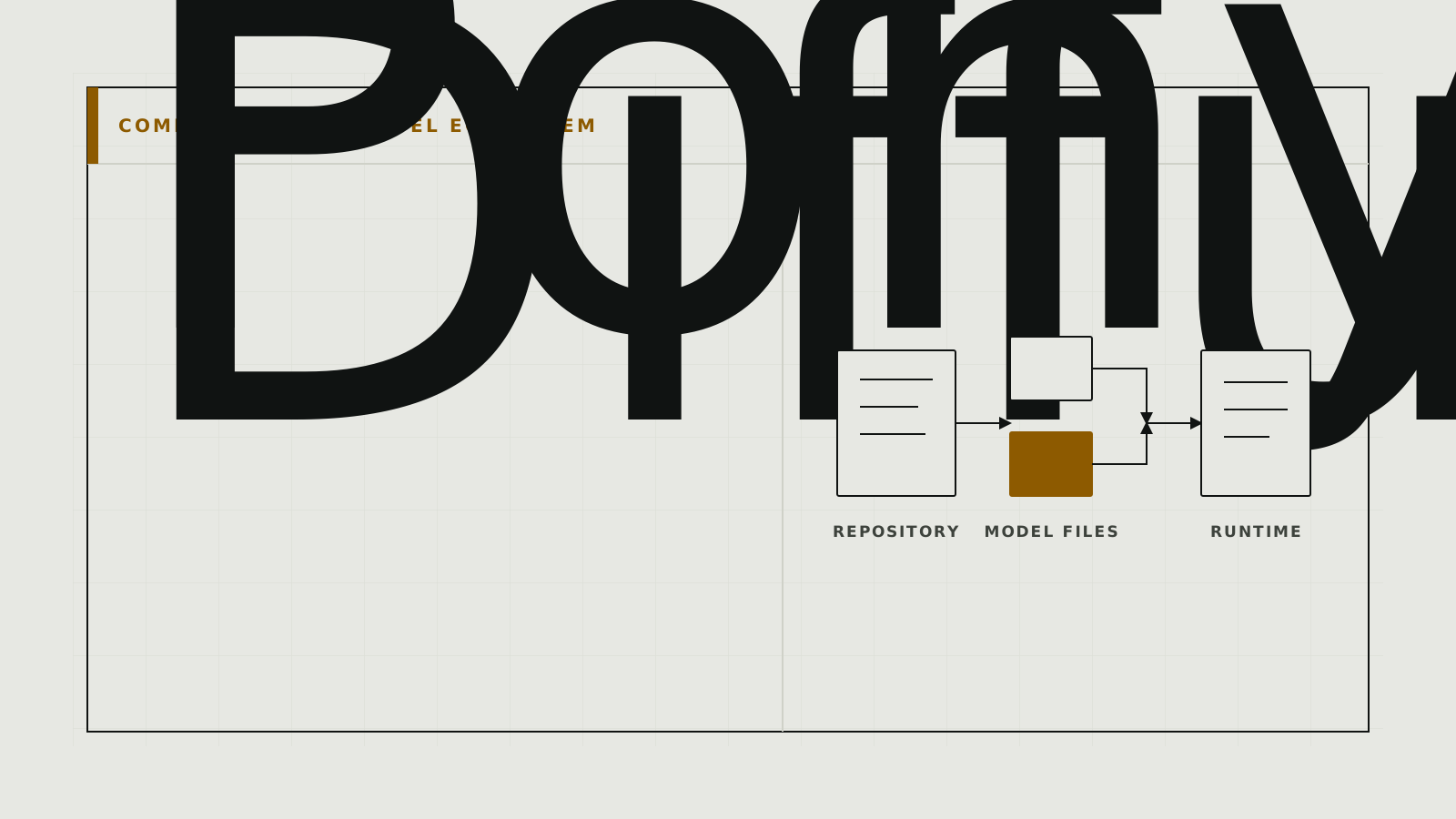
Pony V6 XL retains the SDXL pipeline shape and runs in interfaces such as ComfyUI, AUTOMATIC1111, and Forge. Its LoRA ecosystem is narrower than “all SDXL”: adapters trained specifically against Pony generally preserve its tag distribution better than unrelated SDXL adapters. A resource’s declared base and version should be checked before loading.
Civitai is a major distribution and training surface for this ecosystem. Model-hub metadata can show a declared base, hashes, and files, but it cannot by itself prove lawful training data or safe outputs.
Adult-AI relevance and limits
Pony’s significance to adult AI comes from an illustration/furry-oriented ecosystem, broad character tagging, and many community adapters. This is descriptive, not an endorsement of every resource. Local availability can improve control over storage and workflow, while responsibility for consent, age-appropriate subjects, licenses, and secure inputs remains with the user.
Because the model is strongly fine-tuned, generic SDXL prompting assumptions can fail. Score tags can dominate results, anatomy remains fallible, and descendants may alter style or compatibility. The model name must never be used to infer the contents or policy of a hosted generator.