

Overview
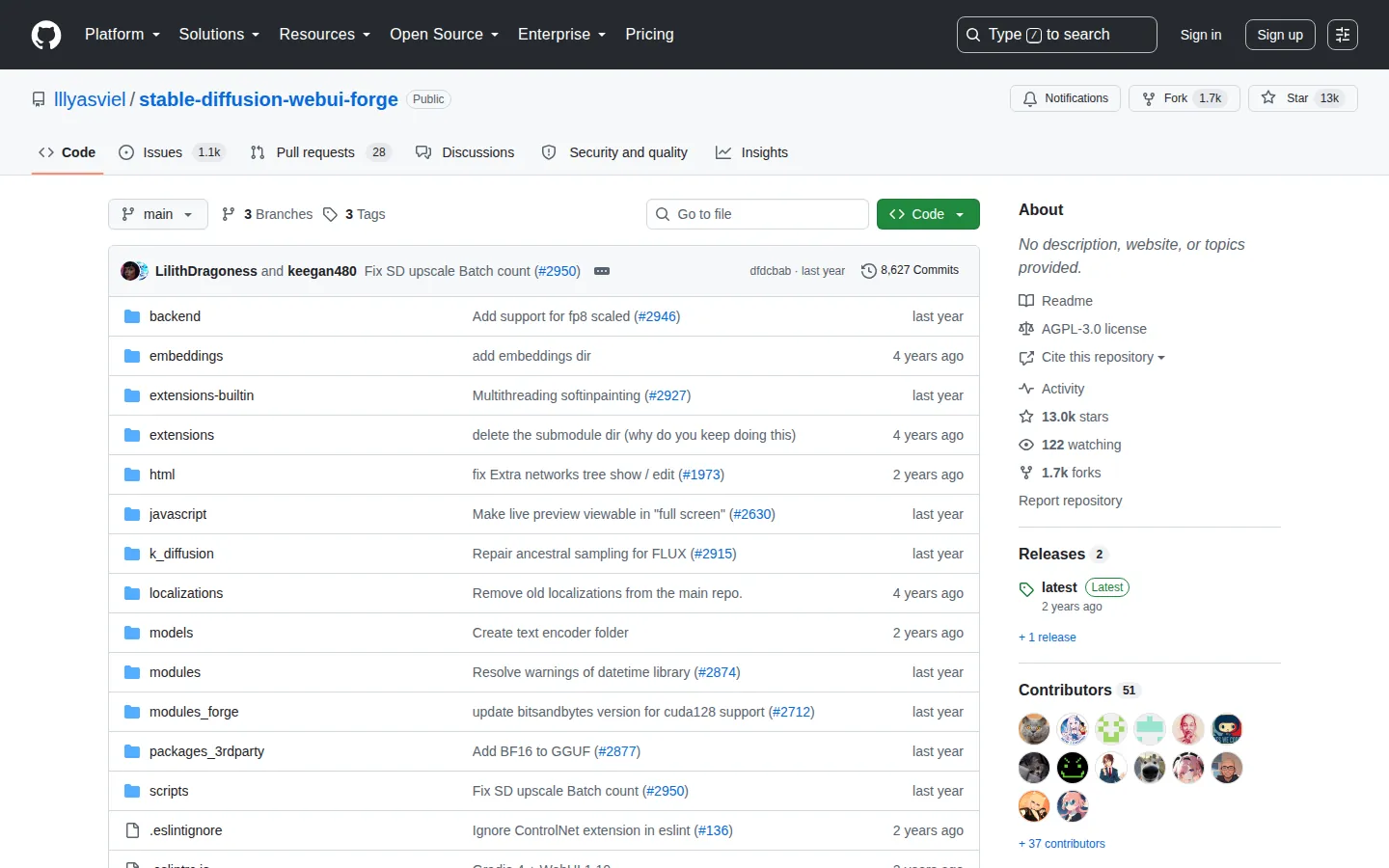
Stable Diffusion WebUI Forge describes itself as a platform built on top of AUTOMATIC1111's Stable Diffusion WebUI to make development easier, optimize resource management, speed up inference, and let its maintainer test experimental features. The name is a deliberate reference to Minecraft Forge (a modding platform built on top of a base game) positioning this project as the faster-moving development layer on top of the more static original WebUI. It is maintained by Lvmin Zhang (lllyasviel), the developer also known for creating ControlNet and Fooocus.
Installation and access
Forge offers one-click installer packages bundling specific CUDA and PyTorch combinations (a CUDA 12.1 + PyTorch 2.3.1 package is the recommended default, with alternate CUDA 12.4 and older CUDA 12.1 + PyTorch 2.1 packages also offered), as well as a standard manual Git-based installation for users who want more control over their environment.
Interface and workflow
Because it's a direct fork, day-to-day use looks almost identical to the base AUTOMATIC1111 WebUI: the same tabbed txt2img/img2img layout and general navigation. The notable interface addition is a canvas tool with pressure-sensitivity support for tablets (tested with Wacom hardware), and a ControlNet panel built directly into the main generation screen rather than living as a separate extension tab.
Model and format compatibility
Forge supports standard Stable Diffusion checkpoints and LoRAs across several quantization formats, plus Flux models using BitsAndBytes NF4 and GGUF quantizations: model compression formats that let large models like Flux run on less VRAM. It also has native support for IP-Adapters, InstantID, and a range of ControlNet preprocessors built into the core interface rather than requiring separate extension installs.
Extension ecosystem
Forge supports both extensions built specifically for it and, to varying degrees, extensions written for the base AUTOMATIC1111 WebUI, though full compatibility isn't guaranteed given the underlying architectural differences in how Forge handles model loading and GPU memory.
Hardware requirements and performance
Forge's core technical claim is a rebuilt GPU memory-management system (referred to in the project as an UnetPatcher-based approach) intended to reduce VRAM pressure and speed up inference compared with the base WebUI. The project does not publish specific quantified benchmark numbers comparing the two, so the practical difference varies by hardware, model, and workflow.
Community and ecosystem
Forge periodically synchronizes with changes from the base AUTOMATIC1111 WebUI (historically on roughly a 90-day cadence or when important fixes land upstream) rather than diverging permanently. A separate community fork, reForge, maintained by a different developer, has also continued independent development building on the same Forge codebase.
Content moderation posture
Like its parent project, Forge ships with no built-in content filter. Any restrictions on what it can generate come from the loaded checkpoint or extensions, not from Forge itself.
Notable features
Built-in ControlNet integration, a pressure-sensitive drawing canvas, a FreeU V2 implementation, and native support for quantized Flux checkpoints: features that in the base WebUI either don't exist or require separate extensions.
Limitations
Because Forge builds on the AUTOMATIC1111 codebase and periodically resyncs with it, it inherits some of that project's underlying constraints, and its own release cadence has fluctuated over time. Full compatibility with every base-WebUI extension isn't guaranteed given the architectural changes underneath.
Important distinctions from adjacent tools
Forge's core differentiator from AUTOMATIC1111's WebUI is the rebuilt memory-management and performance layer under an otherwise familiar interface, plus faster adoption of new model formats. Compared with ComfyUI, Forge keeps the traditional tab-based paradigm rather than a node graph. Compared with Fooocus (built by the same maintainer) Forge exposes the full range of generation parameters rather than hiding them behind a simplified, prompt-first interface.
Technical context
Forge’s loaders, formats, memory manager and controls sit in the broader local diffusion stack.