
What the stack contains
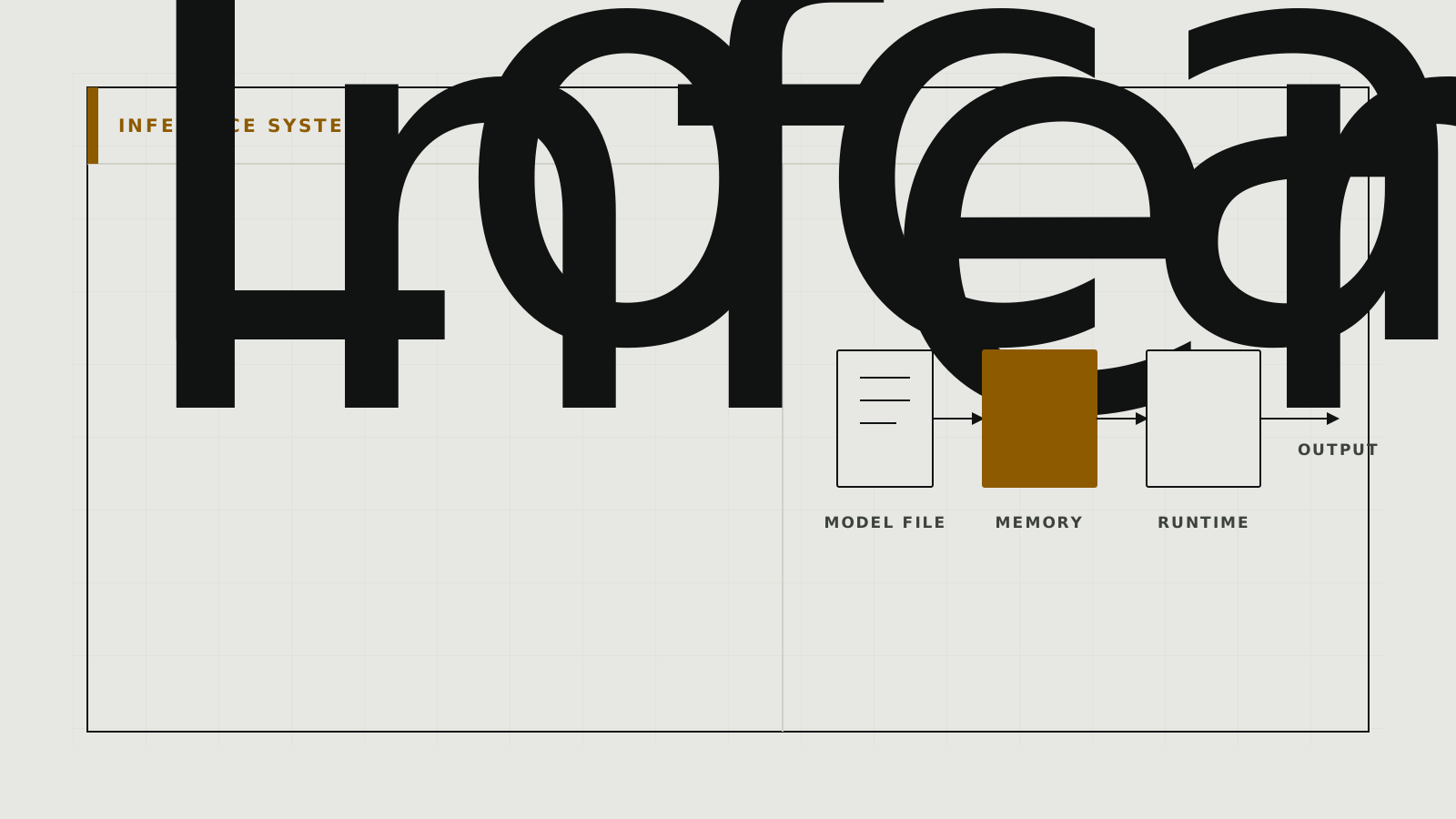
A local image interface is the visible top of a deeper stack: model files on storage; PyTorch or another runtime; CUDA, ROCm, Metal, DirectML or CPU backends; an architecture-aware loader; a pipeline executor; and UI or API. Extensions, custom nodes, preprocessors, and upscalers add executable dependencies.
This explains why two interfaces can load the same checkpoint yet show different speed or peak VRAM. They may schedule components, cache weights, choose attention kernels, or decode VAEs differently.
Interface models
ComfyUI represents pipelines as node graphs and executes changed graph portions. AUTOMATIC1111 exposes a tabbed Stable Diffusion workflow with extensions. Forge retains that interaction style but emphasizes a different memory-management layer and newer model formats. Fooocus automates many choices, while InvokeAI combines managed models with a canvas workflow.
An interface is not a model family. Support must be checked for the exact architecture, weight format, control component, and quantization. A “checkpoint” selector designed around SD 1.5/SDXL cannot infer how to assemble every transformer pipeline.
Memory and performance strategies
Half precision lowers weight memory where hardware supports it. Quantization stores selected components with fewer bits. Model offloading moves whole components between CPU and GPU; sequential or group offloading moves smaller units and can save more memory at greater transfer cost. VAE tiling reduces decode peaks, and attention backends change workspace and speed.
Hugging Face documents these as trade-offs, not universal wins. Measure the real model, resolution, batch, controls, and software version. Large system RAM does not behave like dedicated VRAM.
Reproducibility, privacy, and security
Record model hashes, component versions, precision, seed, dimensions, scheduler, steps, guidance, adapters, and workflow. A PNG may embed useful metadata, but do not assume every export preserves every dependency. Keep a known-good baseline before adding nodes.
Local generation can keep sensitive prompts and sources off a provider’s servers. It is not automatically offline: cloud nodes, telemetry, synced output folders, remote access, package installers, and extensions can transmit or execute data. Bind browser interfaces to localhost unless intentionally securing remote access, and treat downloaded code separately from SafeTensors model files.