

Infrastructure role
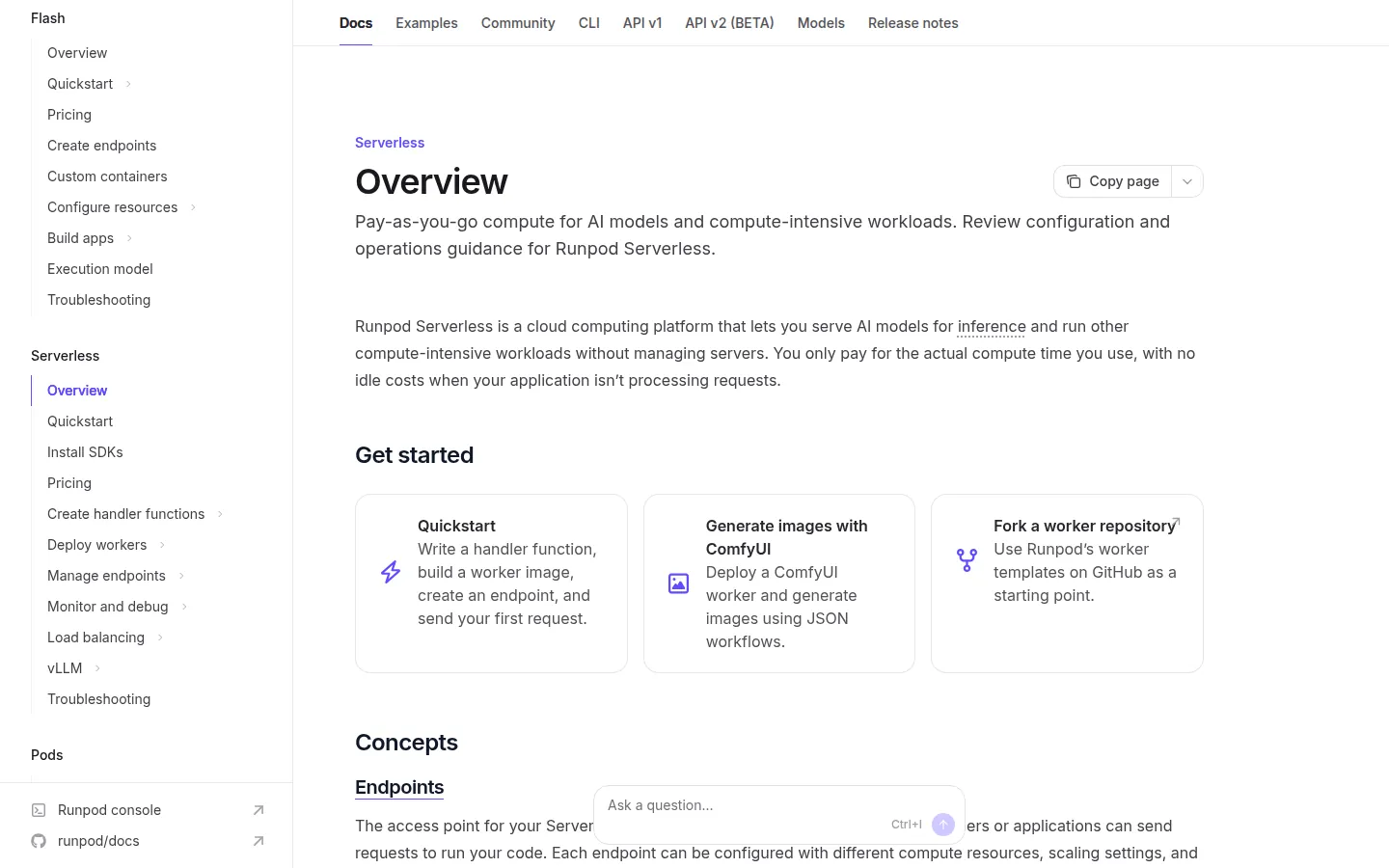
RunPod provides GPU inference infrastructure rather than an adult-content application. A Pod is a configurable container environment that can expose web interfaces or APIs and retain a workspace volume; Serverless packages a handler and dependencies into workers behind an autoscaling endpoint. This places RunPod underneath tools such as ComfyUI, not alongside them as a replacement interface. The distinction matters: RunPod supplies compute and orchestration, while the user's container, model, workflow, and frontend determine what the system does.
ComfyUI and diffusion deployment
The official Serverless tutorial deploys ComfyUI from a Hub listing, accepts workflow JSON, and documents worker images for FLUX.1, SDXL, and Stable Diffusion 3. Custom images can add checkpoints, LoRAs, and nodes. A workflow submitted through an endpoint is hosted generation even when the same JSON and weights could run locally. That changes the privacy boundary, cold-start behavior, storage arrangement, network exposure, and cost model without changing the underlying ComfyUI graph.
Pods, templates, storage, and VRAM
Pod templates combine a container image, hardware specification, storage, environment variables, startup commands, and exposed ports. Official, community, and private templates have different support expectations. Selecting a GPU is also a VRAM decision: model weights, text encoders, VAEs, control models, resolution, video frames, and batch size must fit or use model offloading. Persistent volumes can reduce repeat downloads, but users should confirm what survives a Pod stop or deletion and avoid embedding secrets directly in shared templates.
Limits, policy, and privacy
RunPod is not documented here as an adult platform and does not confer permission to run any specific adult model. Users remain responsible for platform rules, software licenses, model licenses, consent, and lawful data handling. A public endpoint can expose a workflow to unintended callers if authentication and network controls are weak, while uploaded inputs and outputs may persist in container or attached storage depending on configuration. Infrastructure users should treat API keys as secrets, examine worker logs, configure deletion and storage deliberately, and use the upload privacy guide when workflows handle sensitive images.
Technical context
RunPod documents hosted ComfyUI workers and templates for these model families; it supplies infrastructure rather than defining their architectures.