

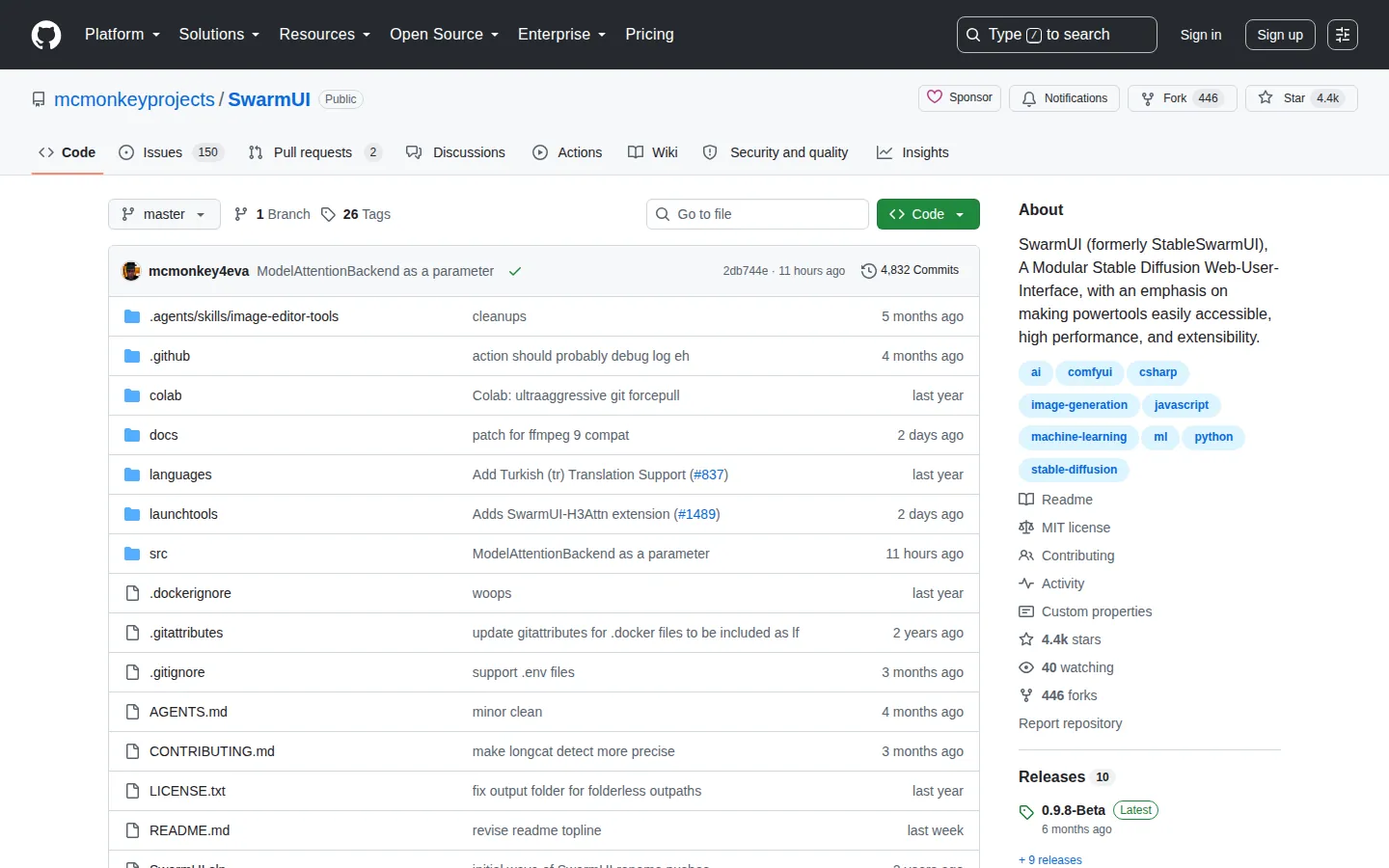
Interface over ComfyUI
SwarmUI's Generate tab presents common parameters without requiring a node graph, while ComfyUI provides the backend and remains available for detailed workflows. The form-based interface suits repeatable adult image workflows that occasionally require node-level editing. Extensions and workflows inherit the same trust concerns as the backend they install into.
Documented model coverage
The project documents Stable Diffusion families, FLUX, SD 3.5, multiple editing models and video families. It supports SafeTensors plus quantized formats such as GGUF and Nunchaku through appropriate loaders. Compatibility is model-specific: a LoRA, VAE, text encoder or ControlNet trained for one base family should not be assumed to work with another.
Control, editing, and API
Prompt regions, image prompting, control inputs, an image editor, refinement and upscaling expose more structure than a plain prompt box. The network API can submit generation and manage the instance, which is useful for creator pipelines. It should not be exposed without authentication and network controls, especially when the model library or output history contains private adult material.
Hardware and local-policy implications
Video models, large FLUX variants and high-resolution refinement can require much more VRAM and system memory than SD 1.5 or a quantized image model. Quantization and offloading can reduce the requirement with speed or compatibility tradeoffs. Local execution removes a hosted generation filter, but it does not make downloaded custom nodes safe or grant permission to create non-consensual likenesses.
Technical context
SwarmUI's official support matrix spans these documented families and local image/video execution layers through its ComfyUI backend.