

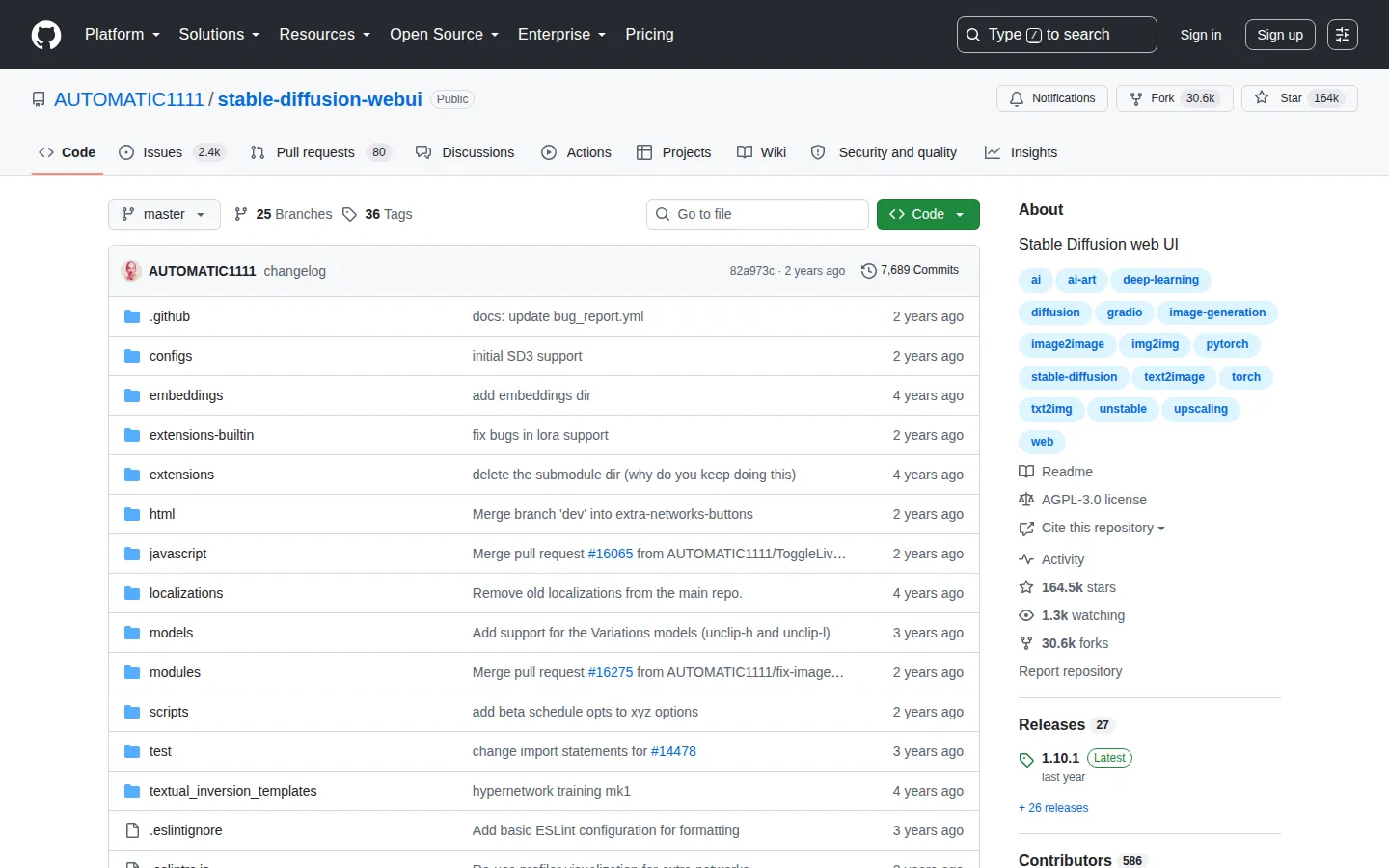
Overview
Stable Diffusion WebUI, commonly referred to by its creator's username AUTOMATIC1111, is a Gradio-based web interface for running Stable Diffusion locally. First released in 2022, it became the dominant way non-developers ran Stable Diffusion on their own hardware and built the template (tabbed txt2img/img2img screens, a settings page, an extensions manager) that much of the local image-generation ecosystem, including forks like Forge, still builds on. As of its 1.10.x release line, active development on the original project has slowed considerably compared to its 2023–2024 pace.
Installation and access
On Windows, installation involves installing Python and Git, then running a batch script (webui-user.bat) that sets up a local environment and downloads dependencies on first launch. Linux installation follows a similar pattern via a shell script (webui.sh) with distribution-specific dependency notes for Debian, Red Hat, openSUSE, and Arch-based systems. Apple Silicon Macs and AMD/Intel hardware are supported through separate documented paths, and the project can also be run through hosted notebook environments such as Google Colab.
Interface and workflow
The interface is organized into fixed tabs: text-to-image, image-to-image, an Extras tab for upscaling and face restoration, a PNG Info tab for reading generation metadata out of image files, a checkpoint merger, and a training tab, alongside a settings screen. Day-to-day use means picking a tab, setting a prompt and parameters in visible fields, and generating. This is a more linear, form-based workflow than ComfyUI's graph editor.
Model and format compatibility
The WebUI supports Stable Diffusion 1.x and 2.x checkpoints natively, plus SDXL (added in version 1.5.0) and, as of version 1.10.0, initial Stable Diffusion 3 support. It also supports Alt-Diffusion and Segmind Stable Diffusion variants. It does not have native support for newer architectures such as Flux, reflecting the project's slower recent development pace relative to tools like ComfyUI and Forge.
Extension ecosystem
A built-in Extensions tab lets users browse and install community-built add-ons directly from the interface, everything from additional samplers and ControlNet support to alternate UI layouts and workflow automation tools. This extension library, built up over several years, is one of the largest in the local Stable Diffusion ecosystem and is a major reason the tool has remained in use even as core development has slowed.
Customization
Beyond prompt and sampler settings, the WebUI supports textual inversion embeddings, prompt editing that changes the prompt partway through generation, saved styles, and a checkpoint merger tab for combining up to three checkpoints into one. Negative prompts and numerous exposed sampler and scheduler options give fine-grained control without needing a node graph.
Hardware requirements and performance
The project's documentation cites 4GB of VRAM as workable on NVIDIA GPUs, with some community reports of running on 2GB cards; training features are documented as needing around 8GB (with reports of 6GB working). AMD, Intel, and CPU-only setups are supported through separate community-maintained guides rather than the main README.
Community and ecosystem
The project built one of the largest user and extension-developer communities of any local Stable Diffusion tool, and remains widely used for SD 1.x/SDXL workflows even though newer model support and core feature development now happens faster elsewhere. Models are commonly sourced from sites such as Civitai and Hugging Face.
Content moderation posture
The WebUI itself has no built-in content filter or moderation system. As with other local tools, what a given install can produce depends on the checkpoint and any extensions the user has loaded, not on the software.
Limitations
Development has slowed substantially since the 1.10.x release line, and the project lacks native support for newer model architectures such as Flux that competing tools added earlier. Its tab-based, form-driven design is also less flexible for building highly customized multi-step pipelines than a node-based tool.
Important distinctions from adjacent tools
Unlike ComfyUI's node graph, this WebUI uses a traditional tabbed form interface, which is generally easier to pick up but less flexible for custom pipelines. Stable Diffusion WebUI Forge is a fork of this exact codebase built specifically to optimize performance and memory use and to move faster on new features, periodically syncing back changes from this project rather than the other way around. Fooocus takes the opposite approach from both, hiding most of the parameters this WebUI exposes in favor of a simplified, prompt-first design.
Technical context
AUTOMATIC1111 packages SD pipelines behind tabs, while model-family compatibility still governs files and adapters.