

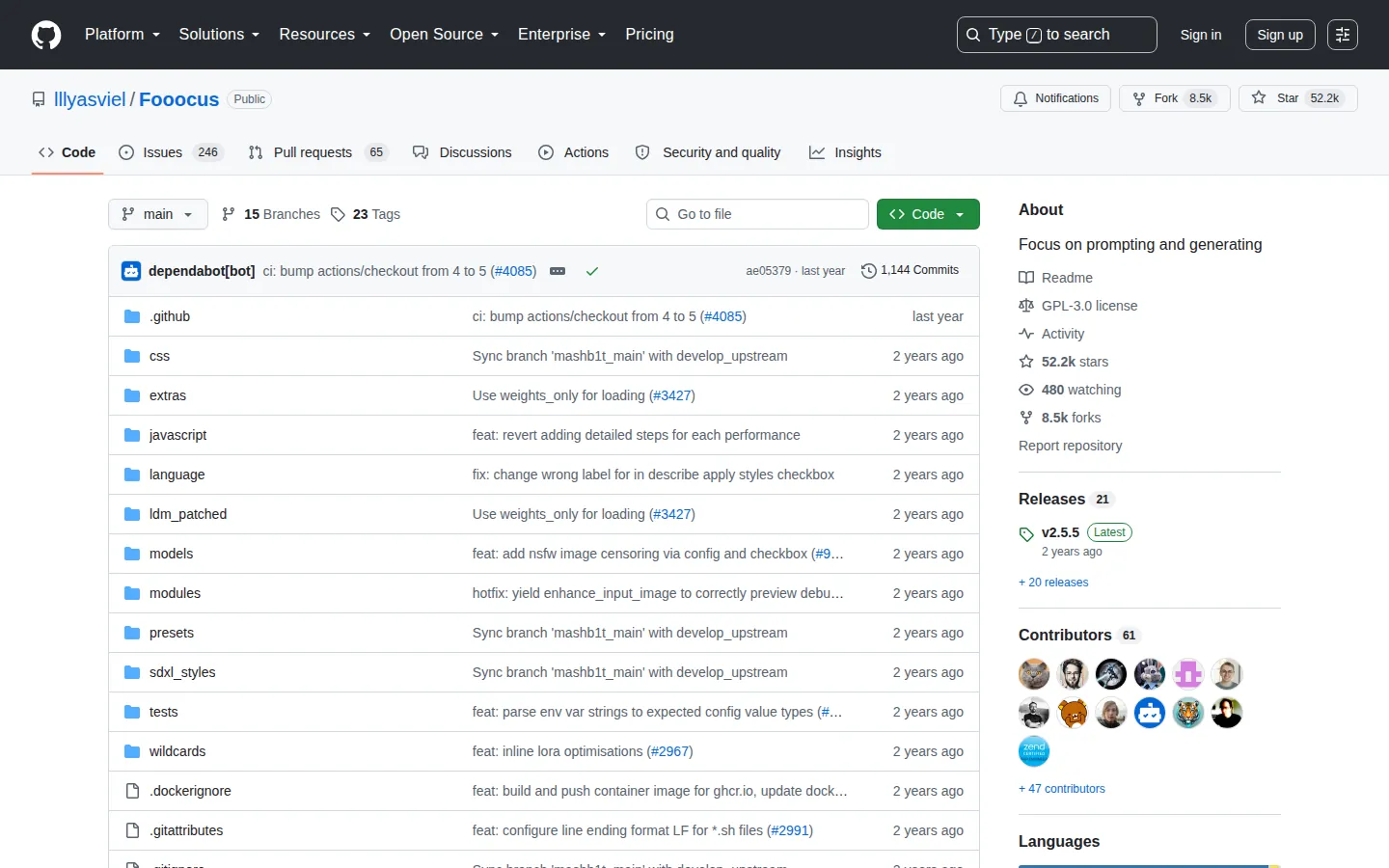
Overview
Fooocus is offline, open-source image-generation software built on Stable Diffusion XL, created by Lvmin Zhang (lllyasviel) (also the creator of ControlNet and Stable Diffusion WebUI Forge) and first released in mid-2023. Its README frames it as a rethinking of image-generator design that borrows the offline, open nature of Stable Diffusion while aiming for the simplicity of prompt-driven commercial tools like Midjourney: users are meant to focus mainly on the prompt rather than tuning technical parameters.
Installation and access
Fooocus is distributed as a direct Windows download, and separately supports Linux installation via Anaconda, a Python virtual environment, or native Python; macOS on Apple Silicon; Docker images; Google Colab notebooks; and AMD GPU variants. The project states that the number of mouse clicks needed between downloading and generating a first image is kept under three.
Interface and workflow
Rather than separate txt2img/img2img tabs and a wall of exposed parameters, Fooocus centers the interface on a prompt box and a set of style buttons, with an optional collapsed "Advanced" panel for users who want more control. Sampler, step count, and other technical settings are handled with defaults behind the scenes unless the user opens the advanced options, making the day-to-day workflow closer to typing a prompt and generating than configuring a pipeline.
Model and format compatibility
Fooocus ships with different default checkpoints depending on the selected preset (Juggernaut XL for general-purpose generation, realisticStockPhoto for photorealism, and animaPencilXL for anime-style output) and is compatible with community SDXL checkpoints, including many hosted on Civitai. It supports LoRAs and weighted prompt syntax.
Customization
Customization is mostly expressed through built-in style presets (including a "Fooocus V2" default style, photograph-oriented styles, and negative-prompt presets) and preset launchers that switch the default model and settings for general, anime, or realistic output. Beyond styles, Fooocus supports inpainting and outpainting, upscaling and image variations, and face-swapping via the InsightFace library.
Hardware requirements and performance
The project documents a 4GB VRAM minimum on Nvidia GPUs (8GB on AMD), at least 8GB of system RAM with swap/virtual memory enabled, and CPU-only operation as an option: though the README states CPU-only generation is roughly 17 times slower than running on a supported GPU.
Community and ecosystem
Fooocus built a substantial following as one of the more approachable local SDXL tools, particularly for users who found webui-style parameter panels intimidating. Default and community-added models are commonly sourced from Civitai and Hugging Face.
Content moderation posture
Fooocus has no built-in content filter. As with other local tools covered here, what it can produce depends on the checkpoint loaded, not on the software itself.
Notable features
A design goal of extreme simplicity (under three clicks from install to first image), built-in style presets, multiple preset launchers tuned for different output styles, and integrated face-swapping via InsightFace.
Limitations
Fooocus is explicitly in "Limited Long-Term Support (LTS) with Bug Fixes Only" status, and its maintainer has stated there are no current plans to migrate to or incorporate newer model architectures such as Flux: users wanting those need a different tool. Its simplified design also means less granular manual control than AUTOMATIC1111's WebUI, Forge, or ComfyUI offer.
Important distinctions from adjacent tools
Fooocus focuses on simplicity. ComfyUI exposes a full node graph, while AUTOMATIC1111's WebUI and Forge expose tabbed panels of technical parameters. Fooocus hides most of those controls behind presets and defaults and is built specifically around SDXL rather than being architecture-agnostic. It has no custom-node or general extension ecosystem to extend it further, and (unlike the actively developed ComfyUI and Forge) is in a bug-fix-only maintenance state with no plans to add newer model architectures.
Technical context
Fooocus automates much of an SDXL-oriented pipeline; these dossiers make hidden components explicit.