
Overview and significance
Stable Diffusion 1.5 is a checkpoint in the first Stable Diffusion family, built around the latent-diffusion design described by Rombach and colleagues. It is not a new architecture relative to v1.4: the model card describes continued training from that earlier checkpoint. Its importance comes from becoming a stable compatibility target for local software, community checkpoints, LoRAs, ControlNets, embeddings, and editing workflows.
That ecosystem role makes “SD 1.5 compatible” more than a version label. It tells a user which tensor shapes, text conditioning, VAE expectations, and adapter family a resource was designed around. A LoRA trained for this family is not automatically compatible with SDXL or FLUX.
Architecture and generation path
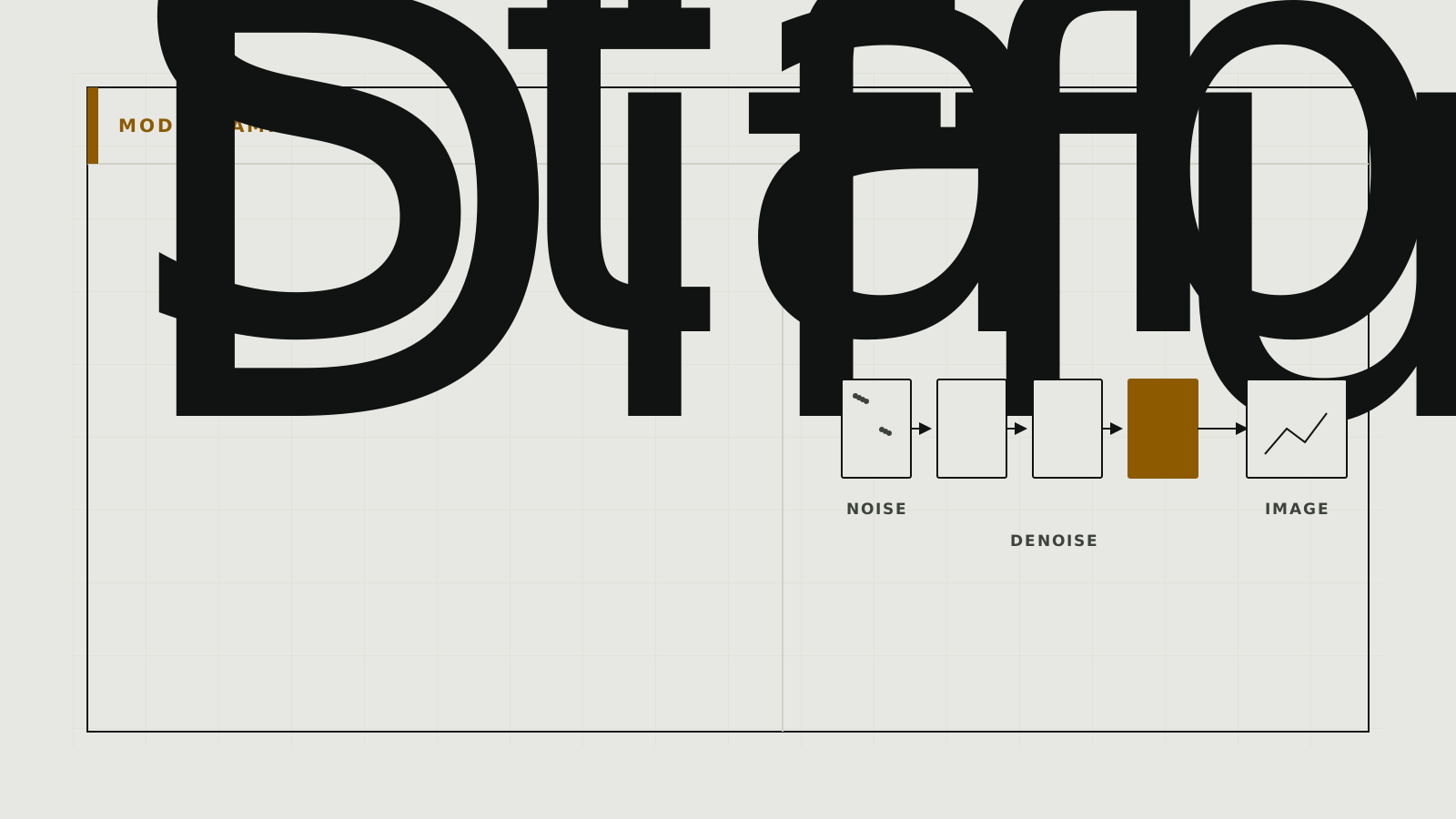
A prompt is processed by a tokenizer and encoded with a frozen CLIP text encoder. A U-Net repeatedly predicts how to denoise a compressed image representation while cross-attention connects text features to the visual process. A VAE then decodes the final latent into pixels. The sampler and scheduler exposed by interfaces control the numerical path through this learned denoising process; they do not replace the model weights.
The v1 model card describes 512 × 512 training. Larger direct generations can stress composition because the learned spatial distribution is anchored to that regime, which is why tiled methods, hires passes, and upscalers became common around the family.
Adaptation and control ecosystem
SD 1.5’s modest size and long tool support made it a practical base for full checkpoint fine-tunes, DreamBooth, textual inversion, and LoRA. ControlNet added spatial conditions such as pose, depth, edges, and segmentation while keeping the original production model locked. These components form a compatibility stack: base family, VAE, control model, and adapter must be selected deliberately.
Civitai distributes many resources in this family, while AUTOMATIC1111, ComfyUI, Forge, and InvokeAI can run it locally. File availability does not establish provenance, training consent, or safe behavior; the model card and resource license remain relevant.
Adult-AI relevance and limitations
For adult-image workflows, the family matters because community fine-tunes and character adapters are abundant, hardware demands are lower than many newer families, and local execution can keep ordinary prompts and source files on the device. Local execution is not automatically offline or private when extensions, cloud nodes, synced folders, or remote APIs are present.
The official model card documents difficulty with legible text, faces and people, complex composition, and prompt fidelity. Community fine-tunes may change output tendencies but do not remove the underlying family’s limits or guarantee anatomy, identity consistency, legality, or consent.