
From U-Net to transformer denoiser
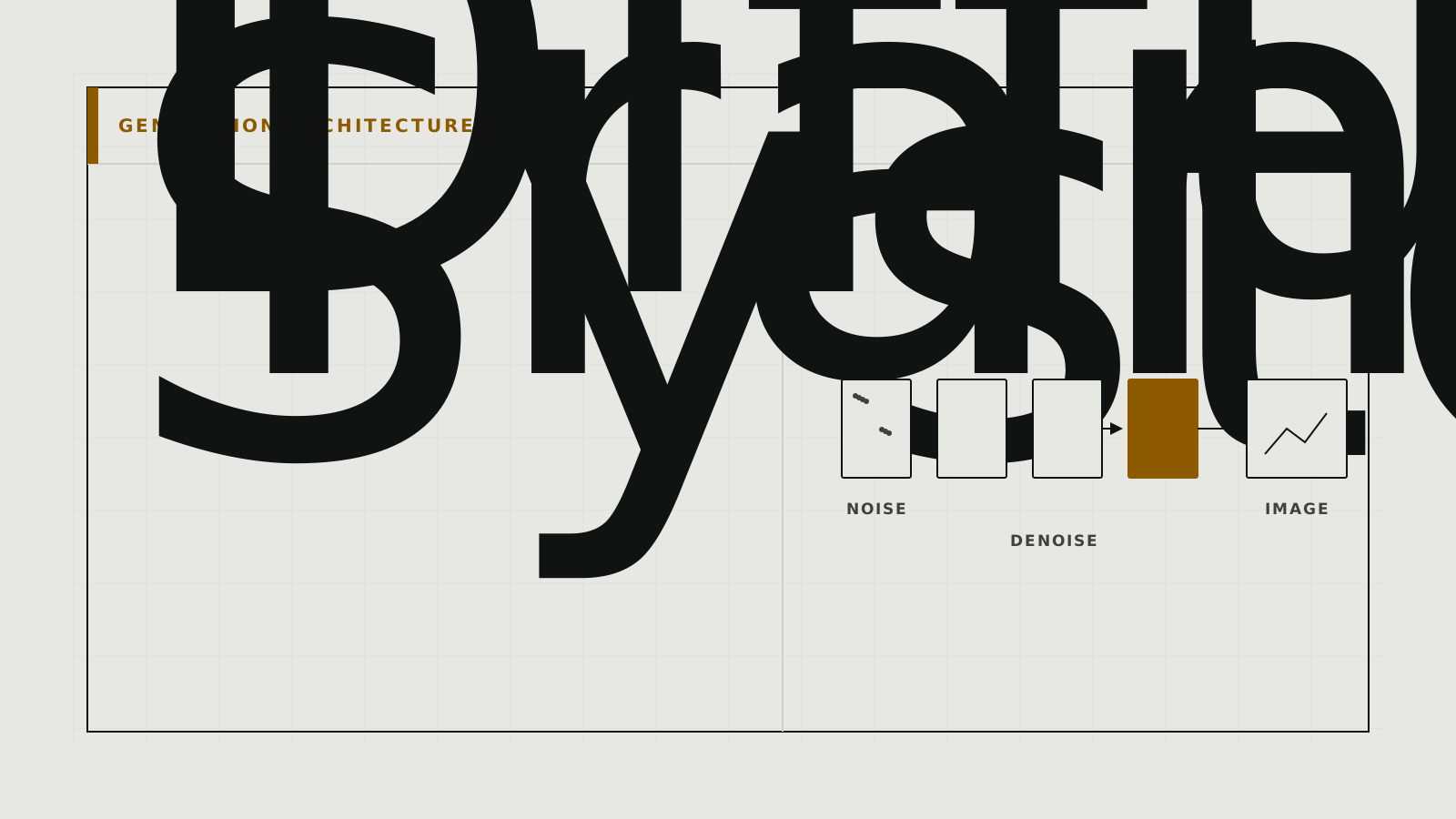
The original DiT paper replaces the common U-Net backbone with a transformer operating on patches of a latent representation. The forward process and iterative generation remain diffusion-like; “DiT” names the denoising backbone, not every part of the pipeline. Text encoders, a VAE, scheduler, and guidance may still surround it.
Transformers make global token interaction and architectural scaling straightforward. The DiT experiments found better image metrics as forward-pass compute increased through depth, width, or more tokens. That research result is not a promise that any larger consumer model is universally better.
Conditioning designs differ
DiT systems do not all inject conditioning the same way. The original class-conditional DiT uses adaptive normalization. Stable Diffusion 3’s MMDiT gives image and text representations separate weights while allowing information exchange. FLUX.1’s released configuration is a rectified-flow transformer with CLIP and T5 conditioning. Similar transformer vocabulary does not imply compatible weights or adapters.
The DiT Glossary page defines the term; model dossiers document what each family publishes.
Inference characteristics
Attention cost grows with token count, so higher spatial resolution and long conditioning can be expensive. Modern kernels, lower precision, quantization, compilation, and component offloading can reduce memory or latency, but support varies by architecture and device. U-Net optimization results should not be copied blindly to transformers.
Large text encoders can account for a meaningful share of download, RAM, and startup cost even if the denoiser dominates repeated steps. Interfaces therefore need architecture-aware loaders, not merely a generic checkpoint picker.
Practical significance and limits
For adult-AI workflows, transformer families bring stronger prompt interaction and new editing/control systems, but often raise the hardware threshold for local privacy. Quantized or offloaded operation may make them accessible with slower generation. Adapter ecosystems remain family-specific.
Architecture labels do not reveal training consent, dataset composition, content policy, or hosted retention. They also do not guarantee identity consistency or anatomy. Those questions require model cards, provider documentation, and empirical validation.