
Model purpose and lineage
Illustrious is an SDXL-based illustration model developed by Onoma AI Research. Its paper positions it as an open foundation for anime-style generation and downstream personalization. The SDXL relationship describes inherited architecture; Illustrious versions remain separately trained checkpoints with their own prompt distribution and license.
The project’s early release, v1.1, v2 and later hosted tiers should not be flattened into one undifferentiated file. This dossier describes the durable family; exact recommendations and availability belong to each version’s official model card.
Published training approach
The Illustrious paper discusses high-resolution illustration data, caption/tag representation, aesthetic conditioning, and refinement stages. It reports experiments intended to preserve character and artist knowledge while remaining suitable for customization. The paper provides more architectural and evaluation grounding than is typical for a community checkpoint.
Not every production version exposes the complete dataset or recipe, and official cards have changed as releases evolved. Where a card omits an internal detail, SDXL ancestry alone is not evidence that the missing training choice matches SDXL base.
Prompt and adaptation ecosystem
Illustrious supports the SDXL-class execution path but learns illustration-oriented tags and natural-language associations from its own training. Fine-tunes and LoRAs increasingly declare Illustrious as their base. That declaration matters because an adapter learns changes relative to specific base weights; a Pony or generic SDXL adapter may load yet behave unpredictably.
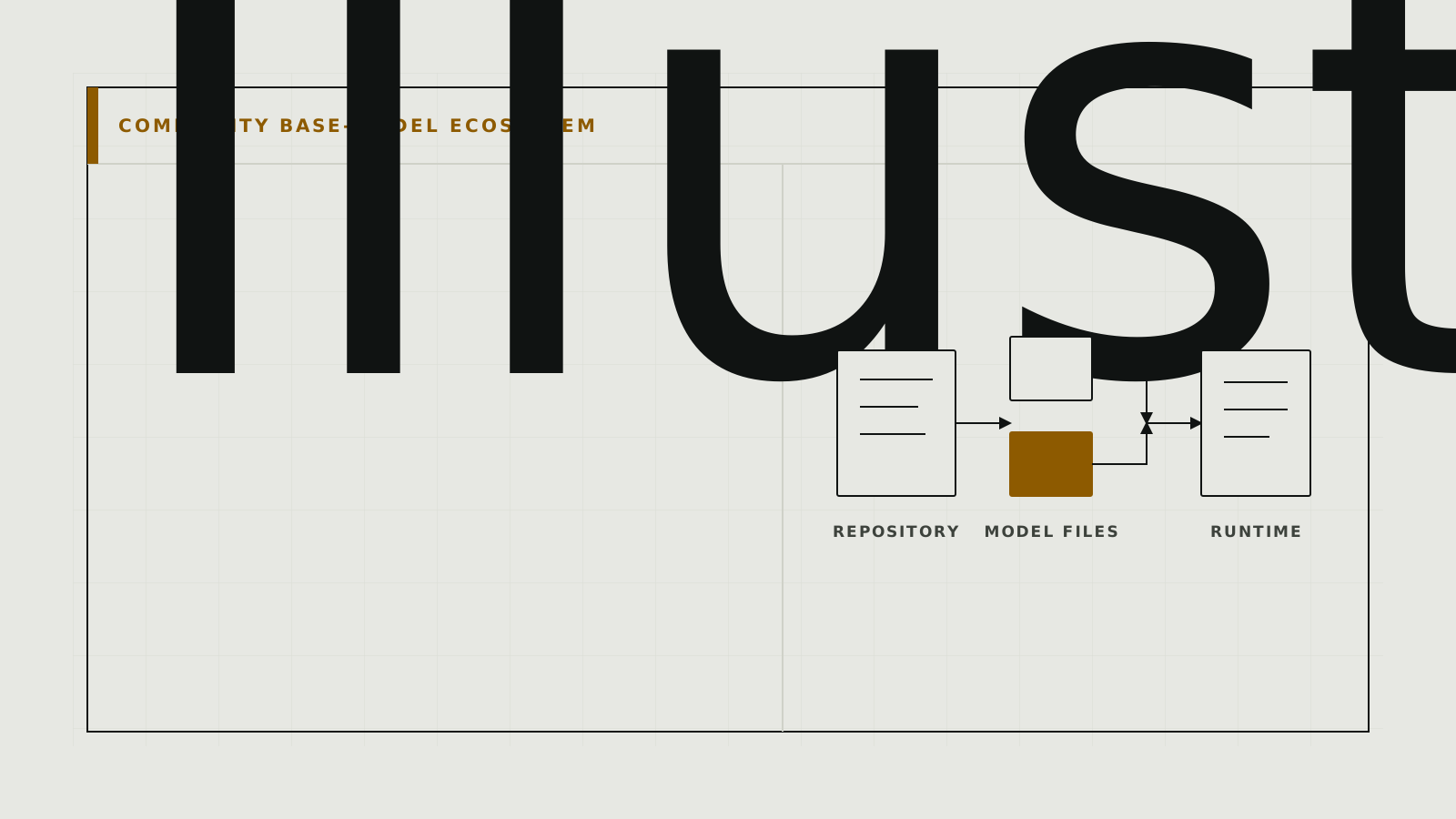
Hugging Face hosts official weights and model cards, while Civitai distributes many descendants. ComfyUI and other SDXL-capable interfaces can execute compatible releases, subject to version, VAE, precision, and license requirements.
Adult-AI relevance and limitations
Illustrious matters to adult-AI research because illustration and character-focused fine-tunes can support consistent fictional-character workflows without relying on a hosted platform. The open ecosystem also increases provenance work: users must verify the actual base, license, model hash, training disclosure, and content policy for each derivative.
Knowledge of named characters or styles is statistical, not a database lookup, and it can be incomplete or miscombined. Prompt adherence, anatomy, text, identity, and fine detail can fail. A style or character LoRA does not establish permission to reproduce a real person.