Get new AI porn site entries, research, and articles.
18+
AI Porn Database is an informational reference resource about adult AI technology.
It does not host or display explicit imagery. Content is descriptive
and does not cover non-consensual or exploitative use cases.
Models & Infrastructure
Tensor.Art
Database · Models & Infrastructure
Reviewed site capture · media censored where required
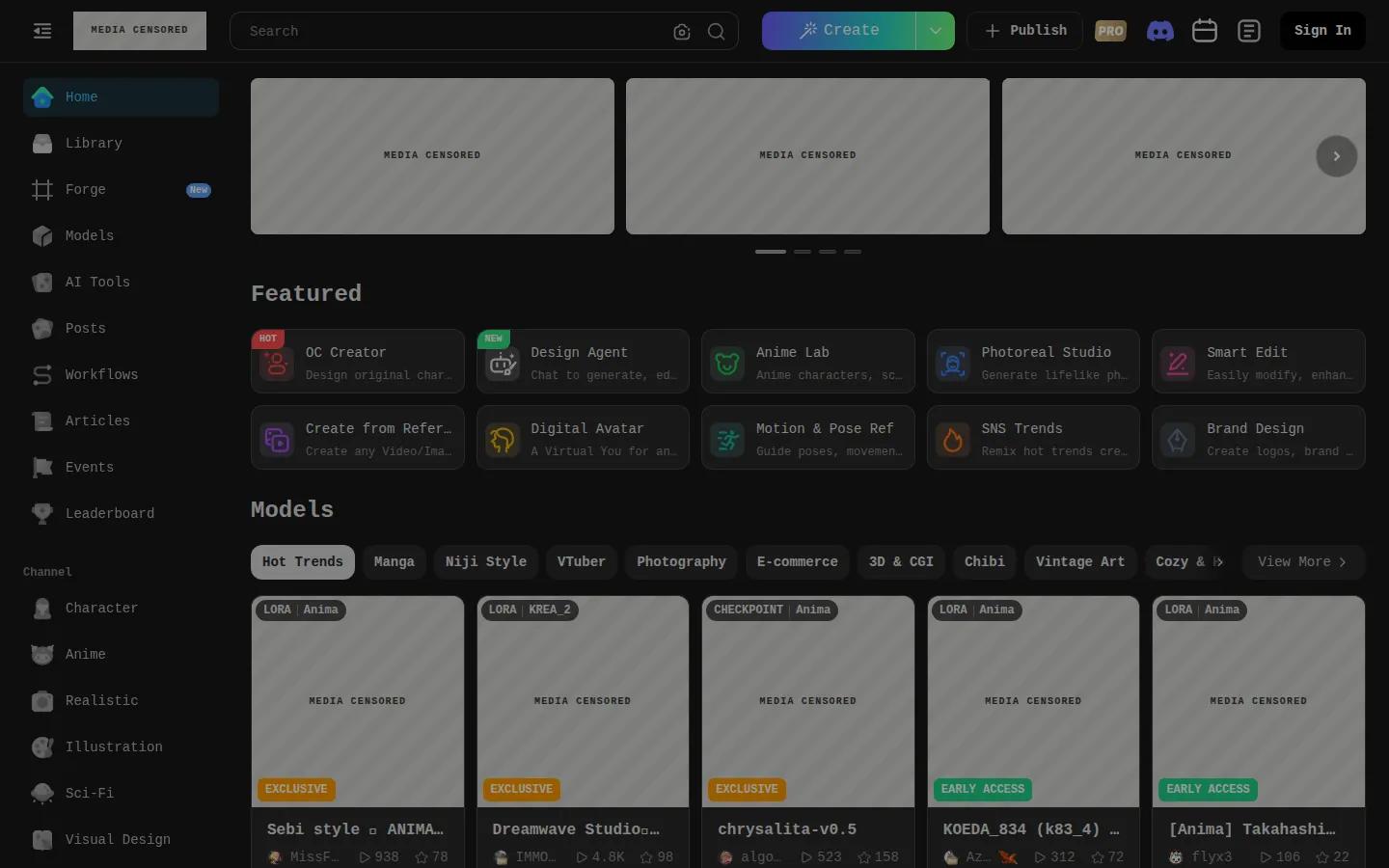
Tensor.Art is a community model and hosted generation platform in the Stable-Diffusion-style ecosystem. Users can browse model resources, run supported models in the browser and train custom resources. It matters to adult-AI research partly because its current policy boundary is restrictive: first-party guidance says explicit sexual material is not permitted for public visibility or generation, even though its terms retain NSFW labeling language.
Tensor.Art combines a model marketplace with hosted generation. Resource pages can distribute checkpoints and LoRAs, while online tools run supported models without a local installation. A downloaded file moves inference to the user's chosen interface, but its license and base-model compatibility continue to apply.
Training and workflows
Hosted training and shared workflows lower the hardware barrier for adapting a model or reproducing generation settings. Training inputs are uploaded to a remote platform, which makes consent and retention review essential for character datasets. A workflow can document parameters and components, but it does not guarantee identical results after model or service versions change.
Current adult-content boundary
The current official content-policy guide says nudity, explicit sexual acts and pornographic material are not permitted for public visibility or generation. The terms also tell users to label graphic or sexually explicit content with an NSFW tag, creating wording that must be read in the context of the newer restrictive guidance. This profile records that tension rather than inferring that age-gated adult generation remains available.
Why it remains relevant
Tensor.Art remains part of the wider checkpoint and LoRA distribution ecosystem used by local creators, and policy changes at a major hosted hub affect where adult model files can be discovered or run. It should not be treated as an adult generator under the current rules. Users seeking local control can evaluate downloadable resources in ComfyUI or another compatible interface, subject to license and consent limits.
Technical context
Tensor.Art distributes and runs community resources; these dossiers explain compatibility and training without inferring undisclosed hosted internals.