

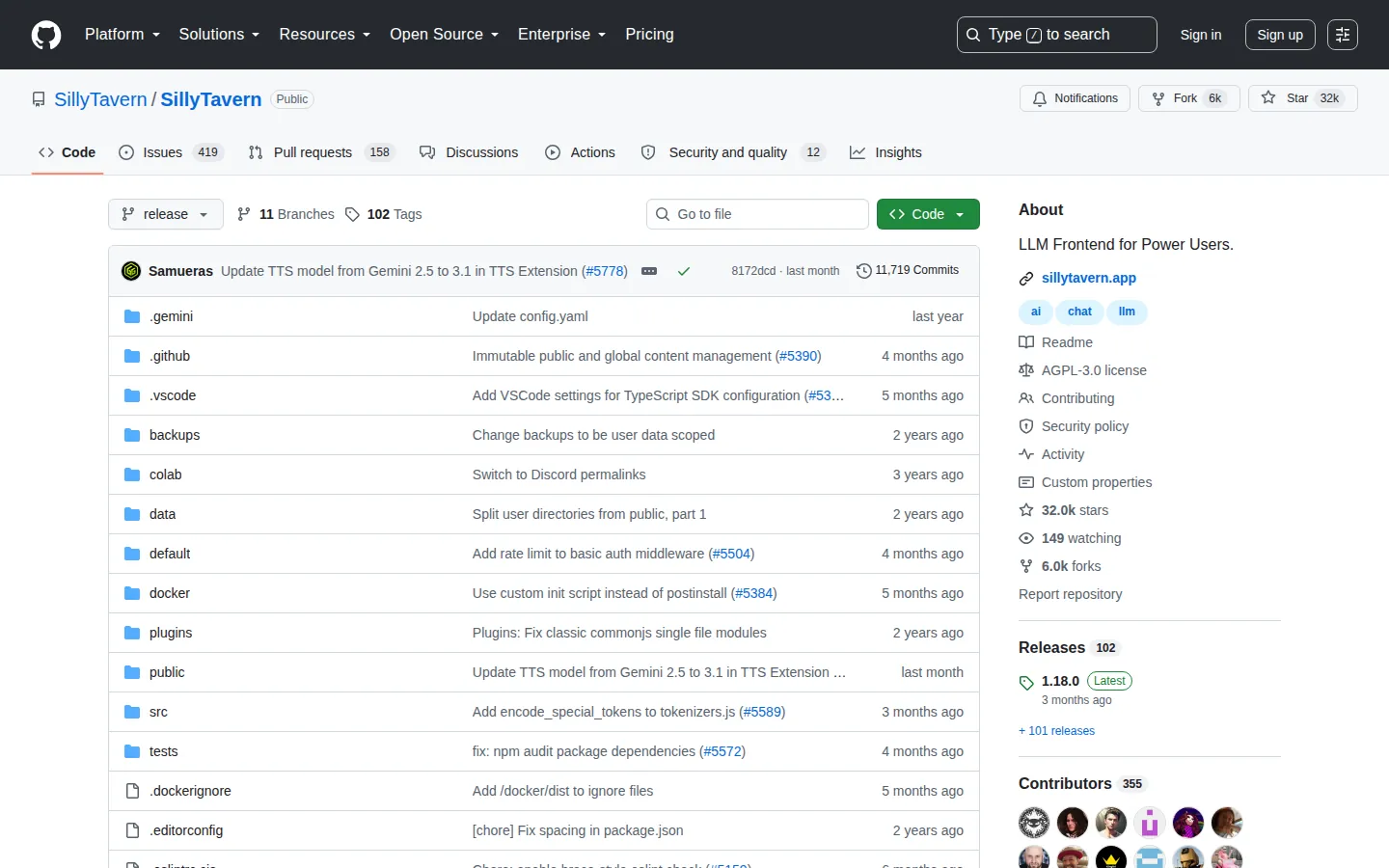
Overview
SillyTavern is a free, open-source chat interface that runs on your own machine and connects to a large language model backend of your choosing; it does not include or host a model itself. It began in February 2023 as a fork of TavernAI and has since become one of the most widely used local frontends specifically for character-chatbot and roleplay use cases, built around character cards, user personas, and lorebook-driven world-building. The project states plainly that it provides no online or hosted service of its own and does not track user data, everything runs locally under the user's control.
Installation and access
SillyTavern requires only Node.js 20 or newer and runs on Windows, Linux, macOS, Android (via Termux), or in a Docker container. Because it's an interface rather than an inference engine, install size and setup time are small compared to tools that bundle a model runtime: the heavier hardware requirements, if any, belong to whatever backend is connected to it (for example, a local engine like KoboldCpp).
Interface and workflow
The core unit of interaction is the character card: a bundle of prompts and metadata (personality, scenario, example dialogue, greeting message) that defines how a given character behaves. Users can create cards from scratch, edit the built-in default character, or import community-made cards. A persona system lets the user define their own name, avatar, and description, with locking rules so a given persona automatically applies to a specific chat or character. Group chats allow multiple character cards to interact with the user and each other in the same conversation, and a Visual Novel–style display mode is available alongside the standard chat log.
Character cards, personas, and lorebooks
SillyTavern's World Info (lorebook) system injects lore or setting details into the prompt only when their associated keywords appear in the conversation, functioning as a dynamic, token-budgeted supplement to raw context-window memory rather than a persistent memory store. Entries can be scoped globally, attached to a specific character card (and exported along with it), or bound to a single chat. Entries support recursive activation (one entry triggering another) and timed effects such as sticky duration or cooldown, letting a world evolve across a long conversation without the user needing to restate everything from scratch.
Model and format compatibility
SillyTavern connects to a long list of backends through its API Connections settings, including local inference engines such as KoboldCpp and other GGUF-based runners, text-generation-webui–style APIs, Tabby, and any OpenAI-compatible endpoint, as well as hosted commercial APIs including OpenAI, Anthropic's Claude, Mistral, and NovelAI's text models. The free, crowd-sourced AI Horde is also supported for users without their own backend. Because SillyTavern is purely a frontend, the actual model being used (and its censorship or lack thereof) is entirely a function of whichever backend the user points it at.
Extension ecosystem
A built-in extension menu supports add-ons for image generation (routed through connected Stable Diffusion, ComfyUI, or DALL-E backends), text-to-speech, automatic chat summarization, UI translation, character sprites/expressions, and web search, among others available for install directly from within the app.
Community and ecosystem
Development is community-driven and happens in the open on GitHub, with an active Discord server for support and a large base of community-authored character cards and World Info files circulating independently of the software itself.
Content moderation posture
SillyTavern is widely used for unfiltered and NSFW-oriented roleplay, but this comes entirely from the flexibility of a frontend with no policy of its own, not from any feature built to bypass restrictions. The software itself ships with no content filter, no age gate, and no moderation layer; what a conversation can produce depends entirely on the connected backend and the specific model loaded there. A hosted API such as OpenAI or Claude will apply its own provider-side content policy regardless of SillyTavern's settings, while a local, uncensored model run through a local backend will not.
Important distinctions from adjacent tools
SillyTavern is a frontend only; it does not perform inference itself, which is why it is almost always paired with a separate engine such as KoboldCpp or LM Studio for local use, or a hosted API for cloud use. This differs from hosted character-chat products like Character.AI or JanitorAI, which bundle their own backend and content policy; with SillyTavern, both the model and any resulting content policy are choices the user makes independently.
Technical context
SillyTavern is the front-end layer; model execution, templates and KV-cache behavior live below it.