

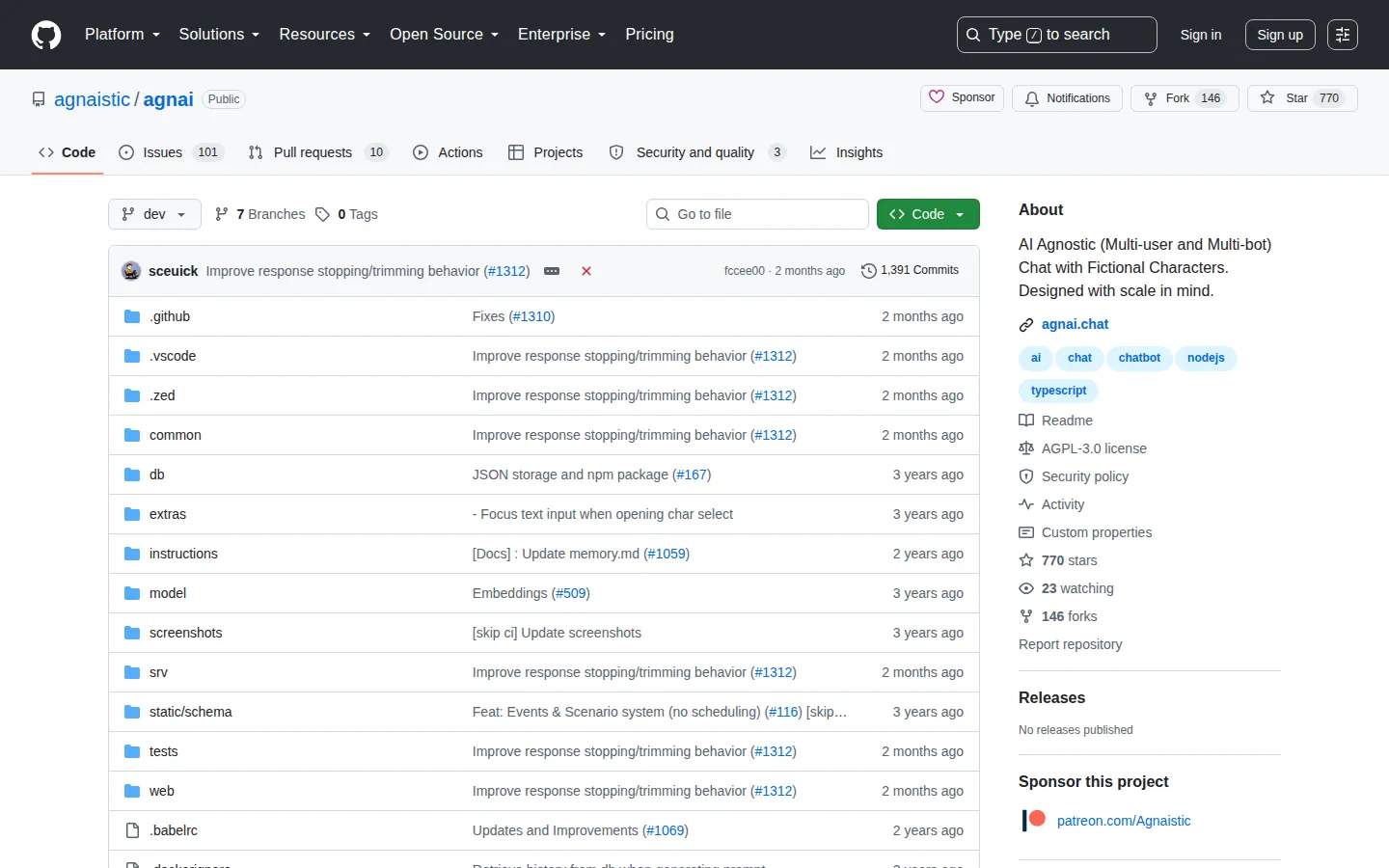
Roleplay architecture
Agnai stores character definitions, user personas, chat state and generation presets, then formats requests for a selected model service. Its provider list spans AI Horde, OpenRouter, Kobold-compatible servers and other APIs. The frontend can therefore support adult roleplay, but no single uncensored-model claim can be applied to every possible connection.
Characters, groups, and memory
The project documents multi-bot and multi-user conversations, multiple persona schema formats, memory or lore books, and AI-assisted character creation. Optional pipeline features add embeddings for long-term chat, article or PDF retrieval. This is a form of retrieval-augmented generation: relevant stored pieces are added to a prompt, not a guarantee that the base model permanently learns them.
Hosted and self-hosted use
The public Agnai.chat instance offers a direct browser path, while the open repository can run in a guest-only configuration using browser storage or with server-side persistence. Browser-local character data on a self-hosted frontend can still be sent to a remote inference API. Users seeking a fully local workflow must pair the frontend with a local model server and avoid remote image or embedding services.
Limits and operational tradeoffs
Provider flexibility increases configuration complexity: prompt templates, stop sequences, context limits and sampler settings need to fit the chosen model. Group rooms consume context faster than one-to-one chat, and embedding pipelines add another data-processing component. The official repository documents the software's features and license, but the public instance's exact model roster and policy can change independently.
Technical context
Agnai's provider-agnostic frontend can sit above local LLM runtimes or hosted APIs, with different privacy and execution boundaries.