

Distributed job routing
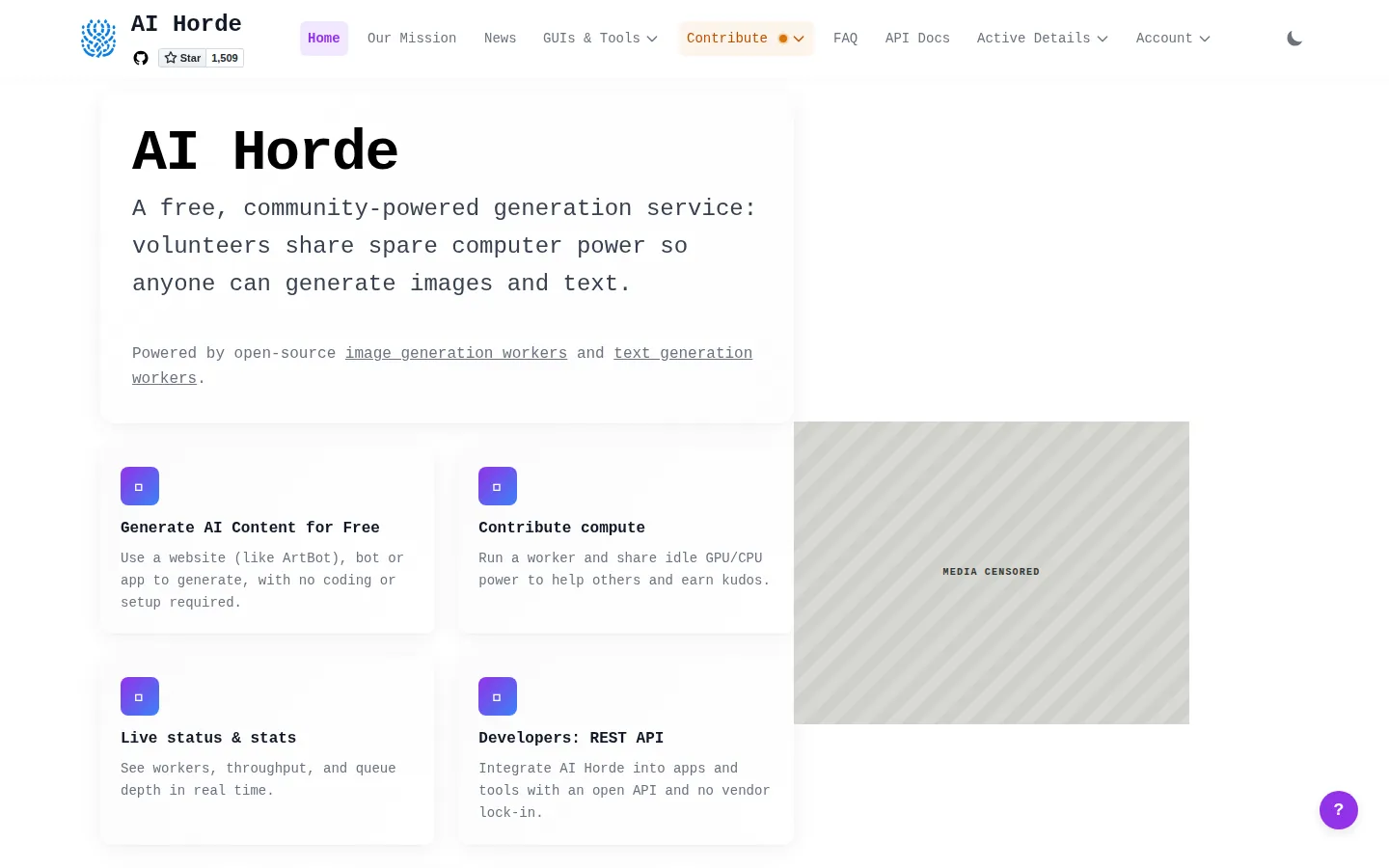
A request enters a queue and is matched to a volunteer worker that advertises the requested model and capabilities. That architecture gives users access without a local GPU, but completion time and model availability depend on current workers. It also differs from local generation: prompts and results travel through shared infrastructure and are processed on a contributor's machine.
Images, text, and models
The public service covers Stable-Diffusion-style image generation and language-model text generation. Its image model reference requires SafeTensors resources and records worker compatibility. The Horde does not develop every model it serves; model behavior, adult capability and license come from each resource, while service-level safety and routing add another layer.
Kudos and access
Anyone can use a documented anonymous API key at the lowest queue priority. Registered users maintain kudos, and workers earn kudos by contributing compute. The project states that kudos cannot be purchased or sold, so it is a scheduling mechanism rather than a conventional paid-credit balance. High load can still make anonymous jobs slow or restricted.
Client integration and privacy
Agnai, Kobold-compatible software and other clients can use the API as a backend. A client UI may look local while the job is remote, so users should inspect the selected provider before sending private roleplay or reference imagery. For sensitive adult work, distributed volunteer inference offers less device-level control than a locally loaded model.
Technical context
AI Horde routes documented image and text jobs to volunteer workers whose actual model and execution stack can vary.