

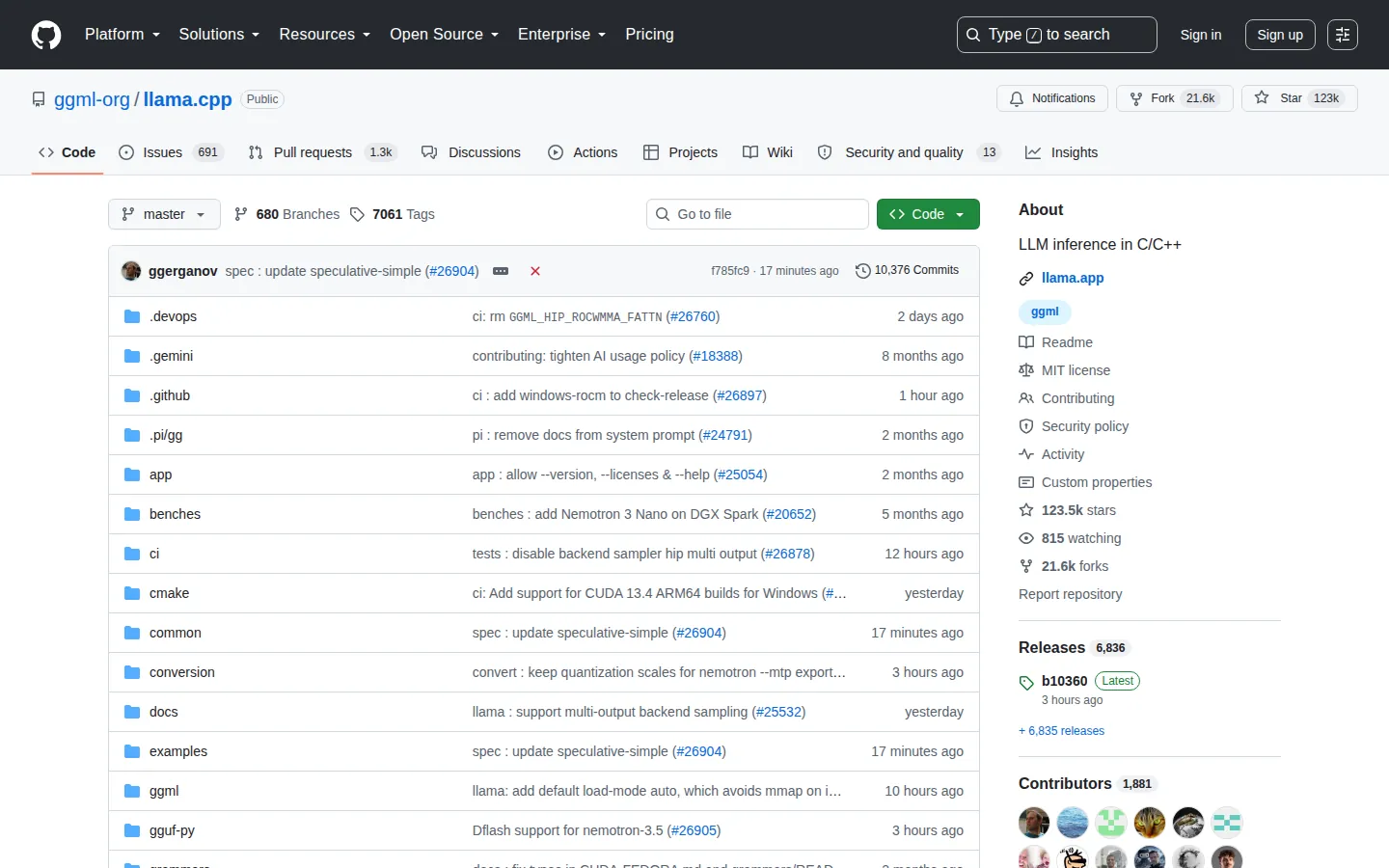
Runtime role
llama.cpp converts model weights into generated tokens; it does not supply a companion persona, memory database or public character library. A frontend such as Backyard AI, RisuAI or SillyTavern can sit above its server. Keeping those layers separate helps diagnose whether a problem comes from the model, prompt template, frontend memory logic or inference settings.
GGUF and quantization
The runtime requires models in GGUF format and includes conversion and quantization tools. Lower-bit quantization shrinks weight files and memory needs, sometimes with a quality tradeoff. CPU-plus-GPU offload allows a model larger than available VRAM to split work across memory pools, but generation can slow sharply when too much computation remains on the CPU.
Server and integration
llama-server exposes compatible chat-completion and other HTTP routes, parallel decoding, continuous batching, speculative decoding, tools and constrained output. That API is why many independent roleplay frontends can reuse the same runtime. A server is local only when it binds to a trusted interface; network exposure should use access controls appropriate to sensitive prompt and conversation data.
Adult-AI relevance and limits
llama.cpp can run roleplay fine-tunes whose model cards document adult or uncensored behavior, but the runtime itself does not certify those labels. Output quality and safety depend on the model, template, context and sampling settings. Local execution can keep prompts off a hosted inference service, while model downloads, frontend plugins and remote access remain separate privacy surfaces.
Technical context
llama.cpp is the runtime layer for GGUF loading, quantization, KV-cache management, offload, and local API serving.